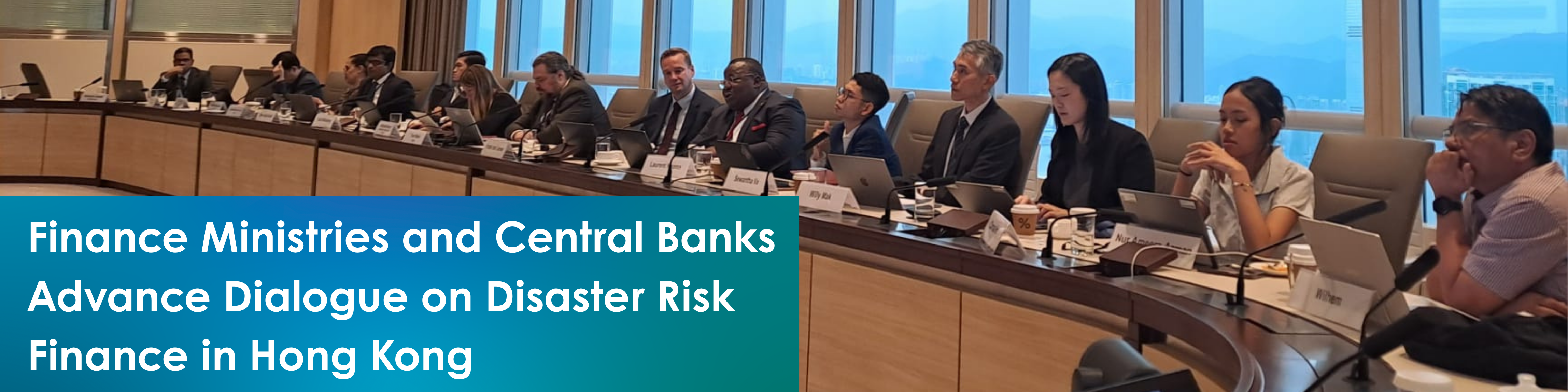
Hong Kong, 10 September 2026 | The Coalition of Finance Ministers for Climate Action (CFMCA) and the Network for Greening the Financial System (NGFS) convened a joint workshop on Disaster Risk Finance and Insurance (DRFI), bringing together Ministries of Finance, central banks, financial supervisors, multilateral development banks and technical partners to exchange experiences on managing the growing fiscal and financial risks associated with climate-related disasters.
The hybrid workshop brought together more than 100 online participants, primarily from Ministries of Finance and central banks, alongside in-person participants, and featured more than 15 substantive presentations and interventions from countries and partner institutions. The level of engagement reflected strong interest from both the Ministries of Finance and central banks in continued work on these issues and in the CFMCA–NGFS Joint Platform as a space to bring the two communities together.
Connecting fiscal and financial perspectives
A central theme of the workshop was the value of bringing together institutions that approach physical climate risks from different but complementary perspectives. Ministries of Finance consider fiscal exposure, contingent liabilities, budgets, debt, public investment, social protection, and sovereign financing, while central banks and financial supervisors bring perspectives on financial-system exposure, risk modelling, supervision, banking and insurance resilience, and financial stability. Bringing these perspectives together can provide a more complete understanding of how physical shocks transmit across the economy and across public and private balance sheets.
This complementarity is at the core of the CFMCA–NGFS Joint Platform. The Hong Kong workshop demonstrated the Platform’s value as a mechanism for facilitating practical exchange and coordination between Ministries of Finance and central banks, while generating country experiences and institutional perspectives that will feed directly into the Platform’s forthcoming synthesis report.
From responding to disasters to preparing financially
Discussions pointed to a clear shift from financing recovery after disasters occur toward ex-ante financial preparedness. Participants highlighted the importance of anticipating and quantifying fiscal risks and putting appropriate financial arrangements in place before liabilities materialize.
Risk reduction and adaptation remain the first line of defense. For the risks that remain, participants discussed layered approaches that combine budget reserves and contingencies, contingent finance, insurance and reinsurance, and other risk-transfer mechanisms, tailored to the frequency and severity of risks and to countries’ fiscal and institutional circumstances.
The discussion also underscored that better data and modelling alone are not sufficient. Risk information needs to translate into fiscal and financial decisions, while prearranged financing needs to be connected to effective delivery systems so that resources can reach affected households and businesses quickly when disasters occur.
Building a shared agenda for action
Country experiences illustrated both progress and continuing challenges in moving toward more integrated disaster-risk-financing systems. These include limited institutional and technical capacity, fragmented responsibilities, affordability and fiscal-space constraints, insurance protection gaps, and residual risks that may be difficult or uneconomic to insure or transfer.
The workshop marked an important step in implementing the first-year strategy of the CFMCA–NGFS Joint Platform. The country experiences, policy discussions, and knowledge and data gaps identified in Hong Kong will contribute to the Platform’s synthesis report and help inform priorities for its next phase. Joint preparation and delivery of the workshop also strengthened collaboration between CFMCA and NGFS and laid the foundation for continued work between the two networks.
The workshop illustrated the role of the CFMCA–NGFS Joint Platform in bringing together fiscal and financial policy perspectives on shared macroeconomic, fiscal and financial challenges. By enabling exchange among Ministries of Finance, central banks, and financial supervisors, the Platform provides a space to compare country experiences, identify common challenges and knowledge gaps, and inform the continued work of both communities.