
Topics
1. Integrating climate risks and economic opportunities into debt sustainability analysis.
2. Designing effective fiscal incentives to catalyze the transition and support jobs, growth, and energy security.
3. Tax expenditure reform to free up fiscal space and address wider macro-fiscal implications.
4. Climate financing instruments – including mitigation and resilience-enhancing financing tools.
Objectives
• Support Finance Ministries to design and implement macro-fiscal policy mixes, including fiscal incentives and public investment strategies, that unlock transition- and resilience-enhancing opportunities and support sustainable growth, competitiveness, energy security, and job creation.
• Enable the integration of climate-related opportunities and risks into macro-fiscal frameworks, fiscal policy design, and medium-term fiscal planning, informed by analysis of impacts on growth, inflation, employment, and external balances.
• Enhance approaches to mobilizing and allocating fiscal space for transition and resilience investments through credible fiscal pathways that balance investment needs with macroeconomic stability and debt sustainability, while supporting a just and inclusive transition.
Priority Outputs for 2026-2027
• Quarterly series of targeted roundtables and convenings to cover each of the four topics.
• These will form inputs into policy or discussion notes of topics 1, 2 and 3, along with a handbook on climate financing instruments.
• Webinar series on the macro-fiscal implications of the energy transition, with a focus on policy responses to energy price volatility and transition-related shocks.
Recent Publications
- Strengthening the Role of Ministries of Finance in Driving Climate Action. A Framework and Guide for Ministers and Ministries of Finance (June 2023)
- Strategies for Mainstreaming Climate Action in Ministries of Finance (February 2022)
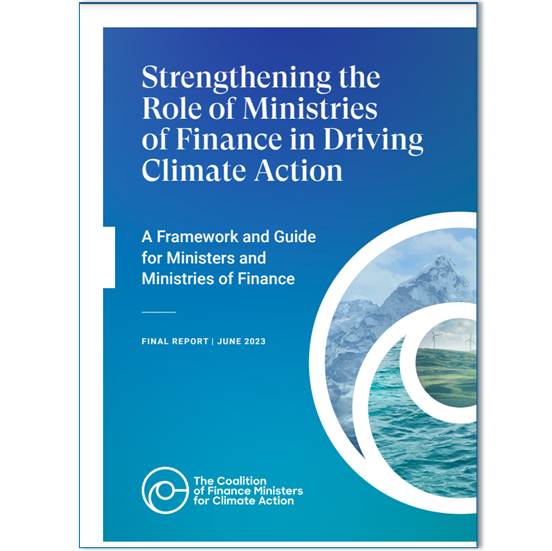
Strengthening the Role of Ministries of Finance in Driving Climate Action. A Framework and Guide for Ministers and Ministries of Finance. (Full Report)
- Published: June 2023
- Pages: 249
- View/Download (ENGLISH)
- View/Download (SPANISH) - NEW!
- Key Messages
- FAQ
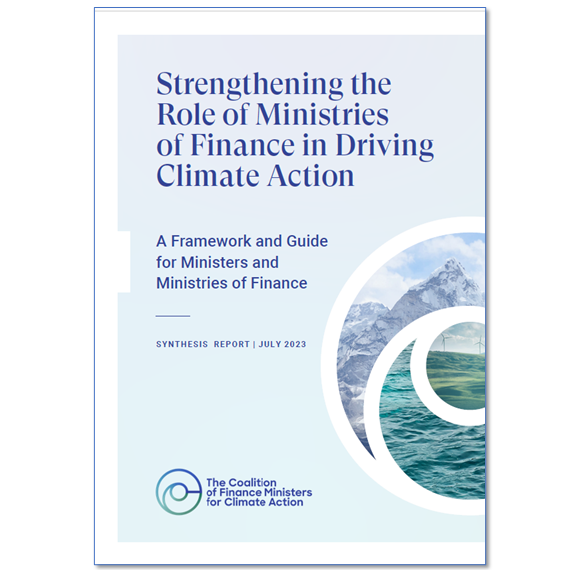
Strengthening the Role of Ministries of Finance in Driving Climate Action. A Framework and Guide for Ministers and Ministries of Finance. (Synthesis Report)
- Published: July 2023
- Pages: 75
- View/Download
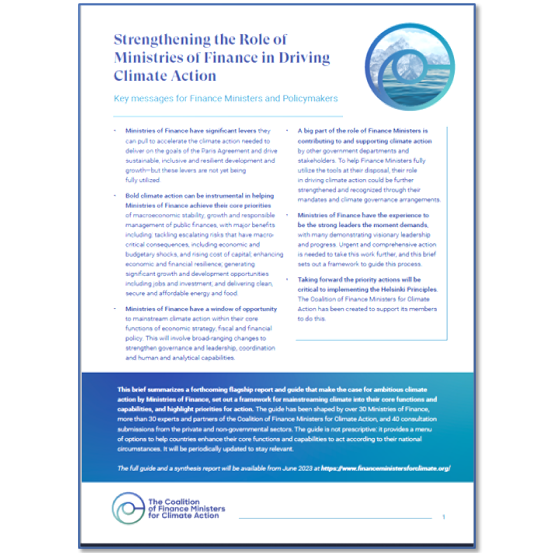
Strengthening the Role of Ministries of Finance in Driving Climate Action. Key messages for Finance Ministers and Policymakers. (Executive Summary)
- Published: April 2023. revised June 2023
- Pages: 11
- View/Download (ENGLISH)
- View/Download (ARABIC)
- View/Download (BAHASA (INDONESIAN))
- View/Download (CHINESE)
- View/Download (FRENCH)
- View/Download (SPANISH)