Climate finance surpassed USD 2 trillion in 2024. Yet adaptation finance has stalled—and finance ministries are increasingly paying the fiscal cost of climate shocks.
Development gains take decades to build, but a single climate shock—such as a cyclone or a flood—can set them back. Finance ministries have to absorb increasing costs when this happens, through emergency spending, repairing public assets, and making up for lost revenue, all while managing rising debt service. The cost of rehabilitation also diverts much needed public resources away from core service provision such as health and education to address recovery efforts from climate shocks.
Stronger investment in adaptation and resilience can interrupt that cycle. Such spending protects what has already been built, reduces future losses, strengthens resilience to shocks, and creates economic opportunities. From this perspective, adaptation is not only a climate policy issue: it is prudent fiscal risk management.
Yet, the finance available to take adaptation action has stopped growing. While global climate finance surpassed USD 2 trillion for the first time in 2024, mitigation finance far outstripped adaptation flows, according to Climate Policy Initiative's latest Global Landscape of Climate Finance (GLCF). Since 2019, tracked adaptation finance has grown at a compound annual rate of 7%. This growth has been uneven from year to year and reflects limited progress from a low base. Modest adaptation growth early this decade has now flattened, with adaptation finance plateauing at USD 69 billion in 2024. The GLCF tracks new financial commitments, rather than disbursements, made by public and private actors, both domestic and international, to real-economy activities that reduce emissions or build resilience to climate impacts; it excludes secondary market transactions and risk instruments such as guarantees and insurance (the methodology for the GLCF is here).
The trends point to the importance of finance ministries treating climate risk and resilience as a core fiscal and financial variable. Viewed through this lens, adaptation investment is a tool to manage fiscal risk, protect development gains, and support durable long-term growth. Directing scarce public resources strategically can also help finance ministries strengthen the institutions and domestic markets needed to finance long-term resilience and build domestic capacity to strengthen economic resilience.
Where adaptation finance flows and where it falls short
Adaptation finance remains concentrated in a narrow group of sectors and providers. Water and wastewater and cross-sectoral activities—including policy support for adaptation and disaster-risk management—accounted for about 80% of tracked flows from 2019 to 2024. Even in these comparatively well-funded areas, investment still falls well short of what comprehensive resilience requires. For finance ministries, this concentration signals a need to identify underfunded solutions across national investment pipelines, and map flows against national priorities to assess alignment and gaps. 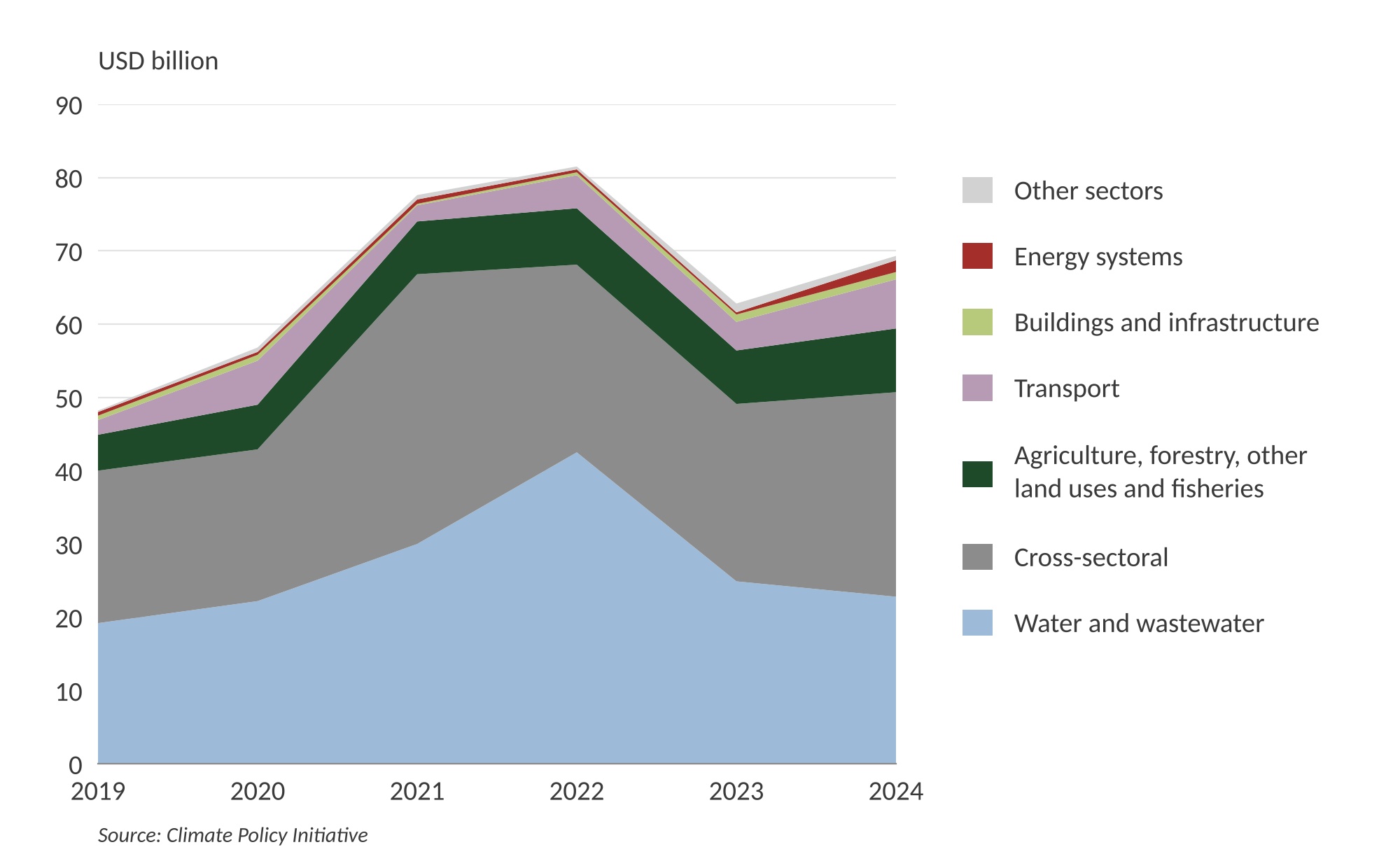
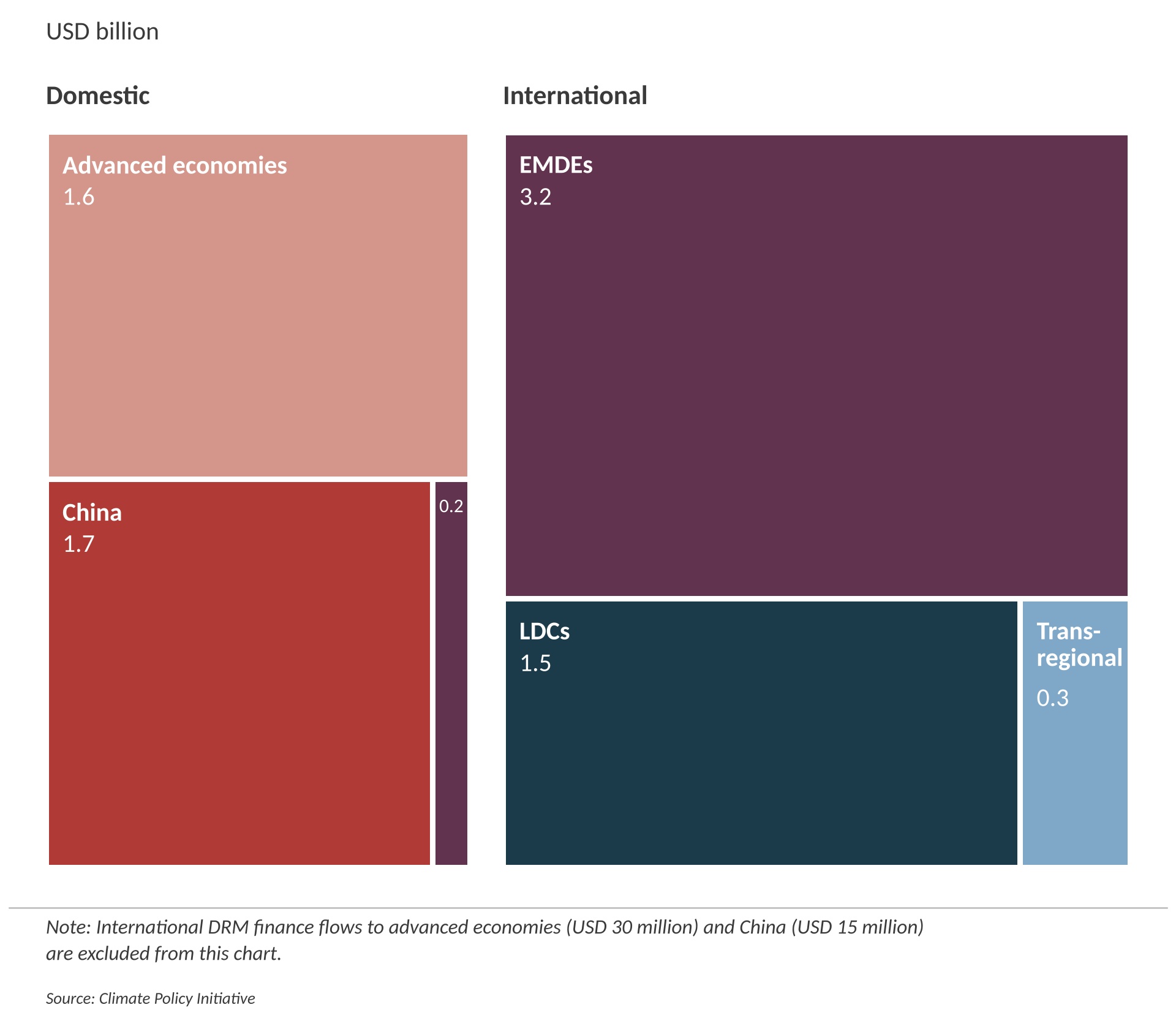
Flows for disaster risk management (DRM) rose from USD 7.4 billion in 2023 to USD 8.6 billion in 2024, but remain far below what is needed given the scale of climate-related risks. Investments in early warning systems, climate-resilient infrastructure, and stronger social protection can reduce losses and speed up recovery from increasingly frequent and severe climate-related disasters. For finance ministries, these investments can also limit future fiscal liabilities and safeguard economic growth.
Least-developed countries received less than USD 2 billion in international finance in 2024 for disaster risk management, far below what they require, given the scale and frequency of disasters they face. The countries with the greatest climate vulnerability are seeing a sharp retreat in external support, compounding pressure on national finance ministries with limited resources to absorb shocks or invest ahead of them.
International public finance continues to form the foundation of tracked adaptation investment, accounting for more than 60% in 2024. Domestic public finance contributed USD 19 billion, or 28% of total flows. National development finance institutions provided USD 11.4 billion, with China Development Bank accounting for 87% of that amount. Green bonds supplied USD 7 billion of domestic adaptation flows and show early signs of use in emerging markets and developing economies. Finance ministries will remain exposed to shifts in donor budgets if their financing base rests mostly on international external public finance and just a handful of domestic institutions. Broadening this base falls directly within their remit, including through better use of green financial instruments such as green bonds.
Private adaptation finance remains the largest missing piece. CPI tracked USD 3.8 billion in 2024, down from USD 8.6 billion in 2023. The apparent year-on-year drop should be interpreted cautiously: totals are sensitive to the timing of a small number of large projects, and data gaps mean that current tracking may understate the full market. However, it must be noted that these tracked private adaptation figures struggle to capture the full scale of relevant financing. Long-standing issues with the identification and classification of adaptation finance, along with limited disclosure incentives and requirements, limit the pool of accessible investment data and place downward pressure on trackable investment.
Commercially viable adaptation finance models do exist, and many private actors, including commercial banks, insurers, asset managers, and pension funds, are beginning to invest. Around 20 adaptation-focused instruments supported by the Global Innovation Lab for Climate Finance have collectively secured more than USD 650 million in private investment. Moreover, a study conducted by GIC, Singapore’s sovereign wealth fund, found that global annual revenues from a select set of climate adaptation solutions are projected to grow from USD 1 trillion today to USD 4 trillion by 2050, indicating a growing investment opportunity for public and private capital. Even so, socially essential adaptation activities that have limited or diffuse revenue streams will continue to require public or concessional finance and are unlikely to attract commercially viable private investment. For finance ministries, the challenge is to distinguish between activities that can be de-risked for private investment and those that will continue to depend on public funding for critical investments in adaptation and resilience.
Headline growth obscures debt and concessionality concerns
Across all emerging markets and developing economies (EMDEs), climate finance reached USD 1.2 trillion in 2024 and grew by 10% year on year, compared with 1% in advanced economies. Yet, this aggregate growth obscures a 17% fall in climate finance for LDCs, to USD 39 billion. International public climate finance also declined by 4% year on year in 2024. Finance ministries in LDCs face a widening mismatch between their climate needs and access to grants and concessional finance to meet their needs without worsening their debt profile.
Adaptation finance can deepen the vulnerabilities it is meant to reduce if delivered through sovereign debt to fiscally constrained countries. CPI's analysis finds no clear relationship between a country's debt vulnerability and the concessionality of the adaptation finance it receives; the most striking mismatch appears among countries at moderate risk of debt distress.
Figure 3 shows how the mix of grants, concessional debt and non-concessional debt varies across countries with different levels of debt distress risk, revealing whether adaptation finance becomes more concessional as fiscal vulnerability increases. On average over 2023–24, it broadly does. The share of non-concessional debt falls from 44% of flows to countries at low risk of debt distress to 36% at moderate risk and 16% at high risk, and disappears entirely for countries already in debt distress, while the share of grants rises from 10% to 73%. Yet debt still makes up a large share of finance to vulnerable countries: 75% of flows to countries at moderate risk and 32% to those at high risk arrive as debt, split roughly evenly between concessional and non-concessional terms. Even concessional borrowing adds to debt burdens that already constrain fiscal space. Moreover, access to concessional finance depends on country classifications (such as income, creditworthiness and debt profiles) that do not always keep pace with changes in debt vulnerability, so some countries may face rising fiscal pressure before their financing terms improve. For finance ministries, these pressures can
delay critical adaptation investment.
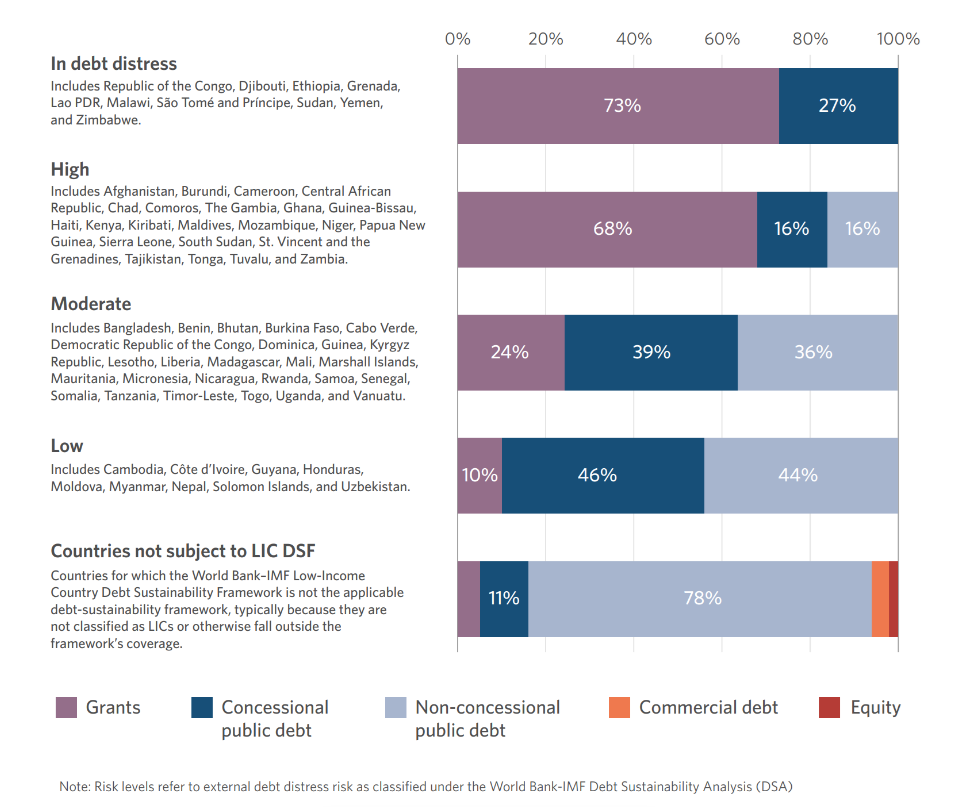
NOTE: Figure compares CPI's data on international public adaptation finance to public-sector recipients in EMDEs, excluding China and EMDEs in Europe, with IMF-World Bank Joint Debt Sustainability Framework classifications for countries with a debt sustainability analysis. It groups flows as grants, concessional debt, or non-concessional debt and compares their distribution across debt-distress risk categories. See Assessing the Quality of Adaptation Finance: A Decision-Support Tool for Public Finance Providers for details.
Implications for finance ministries
For finance ministries, the trends explored above indicate a larger role for domestic and catalytic solutions. Public and blended finance should focus on building project pipelines and de-risking investment where commercial finance is not yet scaling. In EMDEs, high costs of debt and equity can materially increase project costs; guarantees and insurance can help mitigate risk, while catalytic equity remains underused across climate finance more broadly.
The data points to four priorities for Ministries of Finance to consider:
- Treat climate risk as a core fiscal variable. Use a whole-of-government approach to integrate physical climate risk into macroeconomic forecasting, debt-sustainability analysis, medium-term expenditure frameworks, budgets, and existing development pipelines. Climate risk should also be built into capital and investment budgeting, including budget circulars and project-preparation and appraisal guidelines, so resilience becomes a standard design and prioritization criterion. Building the analytical capacity to quantify fiscal exposure helps ministries rank adaptation objectives, translate them into costed, investable strategies, and lay the groundwork for domestic instruments such as resilience bonds.
- Leverage finance instruments and regulatory levers to grow domestic markets. Deploy policy and incentive frameworks that require or reward climate-risk integration by domestic financial institutions, and redirect resources toward existing programs with strong adaptation co-benefits, such as land and water management and social protection. Because the instrument should follow the problem rather than the reverse, the Climate Finance Instruments Toolkit is one resource to help ministry staff compare and shortlist options, from green bonds and guarantees to parametric insurance and debt-for-climate swaps, against sector, credit, and market risks that can then be tailored to the country context and market conditions.
- Work with central banks and regulators to bring physical risk into financial oversight. Incorporate sector-specific physical climate risk into financial-stability frameworks and stress testing, require disclosure of exposure, and ensure sovereign risk assessments reflect both climate vulnerability and the fiscal benefits of resilience investment. By collaborating, ministries can draw on central banks' more mature scenario and stress-testing tools and promote greater coherence and alignment.
- Use scarce public and concessional capital strategically. Where projects are close to commercial viability, public finance can support project preparation, guarantees, insurance, first-loss structures, or catalytic equity to improve bankability and mobilize additional capital. Where markets fall short, grants and concessional finance remain necessary to sustain societally essential adaptation, including activities with limited or diffuse revenue streams. Finance ministries should prioritize projects that domestic and international sources can finance and use public capital to address the specific barriers preventing investment. For international public finance providers, adaptation funding should aim to strengthen and mobilize domestic and private sources of finance. Effectively financing adaptation requires selecting financial instruments that are appropriate for the type of investment and the barriers they are intended to address. Combining grants, debt, equity, and risk-transfer mechanisms across project, market, and system levels can help mobilize finance, strengthen resilience, and improve development outcomes.
From tracking to implementation
Adaptation finance has not yet achieved the steady, broad-based growth needed to protect development gains. International public finance remains indispensable, especially for the most vulnerable countries, while domestic finance and carefully targeted private mobilization must also expand.
Finance ministries are uniquely placed to connect these elements, linking fiscal planning, financial-sector reform, and investment strategy and bringing together country priorities in ways no other actor can. Treating resilience as a core fiscal and financial risk management can turn adaptation priorities into financeable programs and make scarce public resources work harder. The adaptation efforts under the Coalitions’ Workstream on Adaptation, Resilience, and Nature aim to support Ministries of Finance to assess physical climate risks, prioritize adaptation investments, and finance them credibly to protect fiscal stability, sustain growth, and safeguard communities. Through an active working group of Coalition members and institutional partners, the working group will continue to showcase tools, resources, and provide a platform for exchange to help achieve this goal.
Explore CPI's adaptation and resilience resources for tracked finance data, guidance on structuring resilience finance vehicles, and tools to improve the efficiency and effectiveness of adaptation finance.
Check their deep dive on adaptation: https://glcf-adaptation.climatepolicyinitiative.org/
In the GLCF, disaster risk reduction activities, such as early warning systems or integration of climate risk into disaster management plans, form a subset of adaptation finance activities, which include the development of adaptation plans, climate-smart agricultural practices, climate-resilient infrastructure among other activities.