The Coalition of Finance Ministers for Climate Action convened during the London Climate Action Week to formally launch the Thematic Priority 1 workstream of its 2026–2028 strategic work program: From Commitments to Action - Driving a Coordinated Whole-of-Economy Transformation. The event brought together finance ministry officials from Uganda, Spain, Australia, Denmark, Finland, and Croatia to address a long-standing challenge for policymakers: the persistent lack of coordination in translating climate policies and strategies into concrete and effective action.
Three Key Takeaways
1. Finance ministries are key actors in whole-of-economy transformation - as coordinators and risk managers. A whole-of-economy transformation cannot be driven solely by the environment or line ministries. It demands the institutional authority, fiscal tools, regulatory levers, and cross-government reach that only finance ministries possess. Their role spans setting macroeconomic frameworks, allocating public investment, creating incentives, and managing the risks posed by climate change. From stranded assets and transition shocks to cross-border carbon fees and the mounting costs of extreme weather events, climate risk is a macro critical issue. Finance ministries are the custodians of this exposure, and their early engagement in climate planning is essential to ensuring that national strategies are not only ambitious but also economically sound and fiscally sustainable.
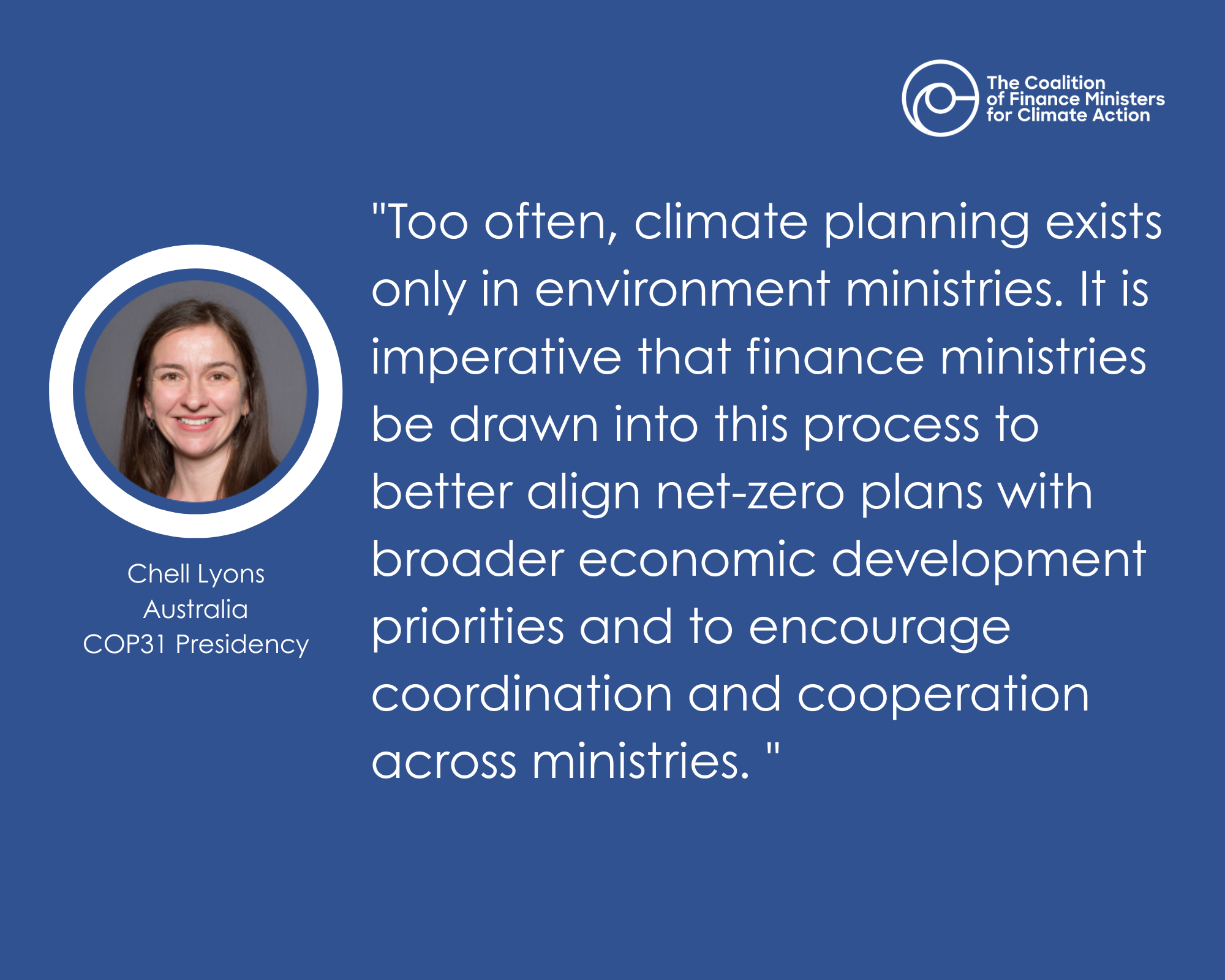
2. Coordination must be institutionalized and built on what already exists. Driving a coordinated transformation across an entire economy requires more than political will; it requires sustainable institutional structures. Effective coordination must work horizontally, across different line ministries and vertically, between national governments and the subnational authorities responsible for delivery on the ground. Critically, each country arrives at this challenge with its own institutional history, existing tools, and sectoral frameworks. Finance ministries should leverage and integrate what line ministries have already built, not duplicate it. Countries shared how they have done so by embedding climate into budget cycles, establishing Climate Finance Units as the connective tissue between sectoral action and national fiscal planning, and moving from isolated project spending to integrated, program-based approaches.
3. Finance ministries must own the climate narrative, not just the purse strings. For whole-of-economy transformation to work, finance ministries must actively shape how climate action is framed: as a structural economic opportunity. Country Climate and Development Reports (CCDRs) are a powerful tool in this regard, linking climate objectives to growth trajectories and investment opportunities in language that resonates across government. Finance ministries that engage early, set realistic budgets, assess and manage risks and champion cross-sectoral investment pipelines are better placed to build the political coalitions that whole-of-economy transformation demands and to ensure that the transition works for every part of the economy.
What Comes Next
The TP1 launch event was the beginning of a conversation, not an endpoint. In the months ahead, the workstream will deliver a series of webinars on CCDRs and Climate Finance Units, sharing practical evidence on how to establish and sustain them across different country contexts. Peer exchange events will carry the conversation forward, with a focus on practical, replicable solutions. Participants also committed to continuing the conversation on closing coordination gaps in climate policy execution, integrating climate into budget processes, developing real-time expenditure tracking tools, and replacing fragmented project spending with program-based frameworks. International collaboration was identified as essential: no country can build the analytical capacity and institutional knowledge needed for whole-of-economy transformation alone. Participants called for deeper international cooperation on macroeconomic modeling and greater support for Least Developed Countries, which face the steepest barriers to accessing climate finance and technical assistance.
As TP1 workstream moves to implementation, the Coalition of Finance Ministers for Climate Action will convene member countries, facilitate knowledge exchange, and develop practical guidance for finance ministries to translate climate commitments into coordinated fiscal action.