
Coalition of Finance Minister events, reports, tools, and highlights
The Coalition is dedicated to providing insightful news updates on global efforts and progress in country domestic climate action we support
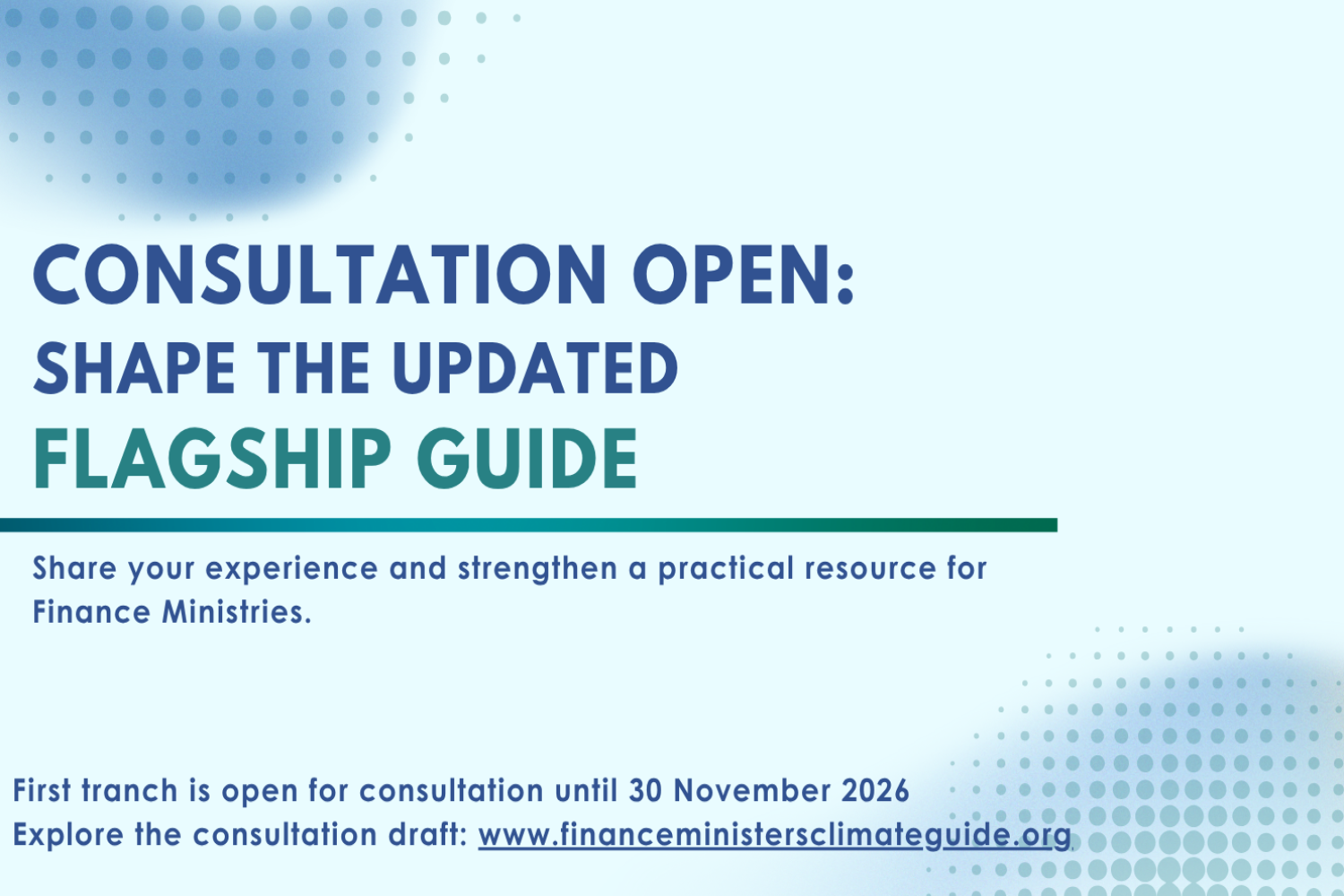
The first Action Areas of the updated Flagship Guide are now open for consultation.
Coalition members and other interested stakeholders are invited to review the drafts and share their feedback, country experience, and implementation lessons to help make the final Guide as practical and useful as possible for Ministries of Finance.
Contribute through the consultation form
Explore the consultation draft on the interactive website and share your feedback
Read the two-page summary for policymakers.
Consultation until 30 November 2026
The Network for Greening the Financial System (NGFS) and the Coalition of Finance Ministers for Climate Action (CFMCA) have launched a new joint dialogue platform to deepen knowledge sharing between central banks and finance ministries on the macroeconomic dimensions of climate change and the transition to a low-carbon economy.
Check the previous and upcoming joint events here.

The Coalition’s program in Bangkok brings together ministerial leadership, regional and technical dialogue, and practical exchanges on climate and economic policy and reflects its growing focus on implementation, peer exchange and strengthening the role of Finance Ministries in climate action.
Read our main outcomes:
And follow us on LinkedIn for daily updates.
Thematic Priorities






About the Coalition
Finance Ministers hold the keys to accelerating climate action. They are most clearly aware of the risks posed by climate change and recognize how taking action could unlock trillions in investments and create millions of jobs by 2030.
The Coalition of Finance Ministers for Climate Action brings together fiscal and economic policymakers from 100 countries to lead the global climate response and secure a just transition towards low-carbon, resilient development.
104 Member Countries
Member Countries









Strategic Work Program and Annual Report
Read the Annual Report and the Strategic Work Program
Pakistan Finance Minister Muhammad Aurangzeb said that climate change had already impacted food production and the livelihood of millions in Pakistan.
March 31, 2025
Pakistan was ranked the most vulnerable country to climate change in 2022, followed by Belize and Italy, according to data in the Climate Risk Index (CRI) for 2025 report released by European think tank Germanwatch last month.
Addressing a ceremony in Islamabad marking the first ‘World Day of Glaciers,’ Pakistani Finance Minister Muhammad Aurangzeb said: “This disturbed water cycle [due to rising global temperatures] is already impacting crop yields, food production, and the livelihood of millions.” This highlights the severe consequences of climate change on Pakistan's food production and the livelihood of millions.
“We need to come up with well-structured projects to access climate financing,” he remarked, assuring that the Ministry of Finance would extend full support in tackling the crisis.
Pakistan has faced unprecedented floods caused by record-breaking monsoon rainfall and glacial lake outburst floods (GLOFs). With over 3,000 glacial lakes, 33 of which are highly volatile, the danger to millions is alarming.
The government is launching the country's first Glacier Conservation Strategy to protect these vital ecosystems. Continuous glacier retreat leads to extreme events and evolving disaster risks for downstream populations. Glaciers are crucial for regulating the global climate and providing fresh water for billions of people.
East Africa Region Holds Director-Level Climate Finance Meeting
February 22, 2025

Joel Muhinda participated in on behalf of the Co-Chairs and delivered a featured presentation at the recent East Africa Climate Finance Director Level Meeting held in Arusha, Tanzania, on February 17-21, 2025.
The conference gathered finance directors and policymakers from across the region to explore various dimensions of climate finance, emphasizing the enhancement of regional capabilities and cooperation in tackling climate challenges.
Muhinda's presentation “Leveraging the Coalition of Finance Ministers for Climate Action,” underscored the crucial role of finance ministers in mobilizing climate finance. Collaborating with esteemed entities such as the Ministry of Finance, Planning and Economic Development (MoFPED), the East African Community, the Foreign, Commonwealth & Development Office, the Global Green Growth Institute, and The Coalition of Finance Ministers for Climate Action, they discussed strategic approaches to fortify climate finance frameworks essential for sustainable development and resilience across East Africa.
The session highlighted the need for innovative financing mechanisms and robust regional cooperation to reach the ambitious targets set at COP29.
Bangladesh Climate Development Partnership (BCDP) Launched to Leverage Adaptation and Mitigation Investments
January 27, 2025

The Government of Bangladesh approved the Bangladesh Climate Development Partnership (BCDP) in May 2024 to drive climate actions at scale and with urgency. The BCDP is a country-led climate platform established to optimize the implementation of climate actions and is recognized by the global community as an important modality for delivering climate actions on a large scale. An ADB-funded project – Operationalizing the Bangladesh Climate Development Partnership – involving USD 1 million was launched on 26 January 2025 to operationalize the BCDP as a cross-sector, multiyear climate action partnership aimed at mobilizing climate finance, accelerating policy reforms, enhancing capacity for innovative climate projects, and facilitating knowledge sharing.
Dr. Sam Mugume Leads Key Discussions on Climate-Resilient Fiscal Policies
February 10, 2025

Dr. Sam Mugume, the incoming Co-Chair from Uganda, recently took part in two critical events that underscore the intersection of climate action and fiscal policy. On the 5th of February 2025 he was the keynote speaker at the launch of an important report by UNEP and Oxford University: Enabling Adaptation: Sustainable Fiscal Policies for Climate-Resilient Development and Infrastructure. The report emphasizes that climate adaptation is not just a moral imperative; it is also an economic and fiscal necessity for developing countries and least developed countries. It highlights frameworks and strategies for managing scarce financial resources, including sustainable budgeting and risk-sensitive debt analysis. “We must also move beyond viewing resilience solely through the lens of risk management, as there are significant short-, medium-, and long-term gains from applying a "resilience-first" approach to fiscal decisions”.
On January 21st and 22nd, 2025, he was invited as deputy from the incoming co-chair country to join distinguished speakers and delegates from around the world to discuss how we can assess and enhance national public finance management systems to better address key economic challenges and shocks resulting from climate change. The theme of the Green Public Financial Management Seminar in Kigali, Rwanda "COLLECT MORE, SPEND LESS," emphasized the importance of prudent fiscal policies for countries, while also promoting forward-thinking and wise use of resources. The challenging question is: Are developing countries ready for this? The gains, opportunities, risks, and tools were thoroughly discussed.
“The choices we make now can lay the foundation for resilient economies and equitable societies for generations to come. As public finance managers we should understand our unique position to help accelerate a just transition to a low-carbon and climate-resilient economy through public financial management, macroeconomic and fiscal policy; and where applicable, financial regulation. As Uganda assumes the role of Co-Chair of the Coalition of Finance Ministers for Climate Action, we are committed to leading this effort with humility and determination”.
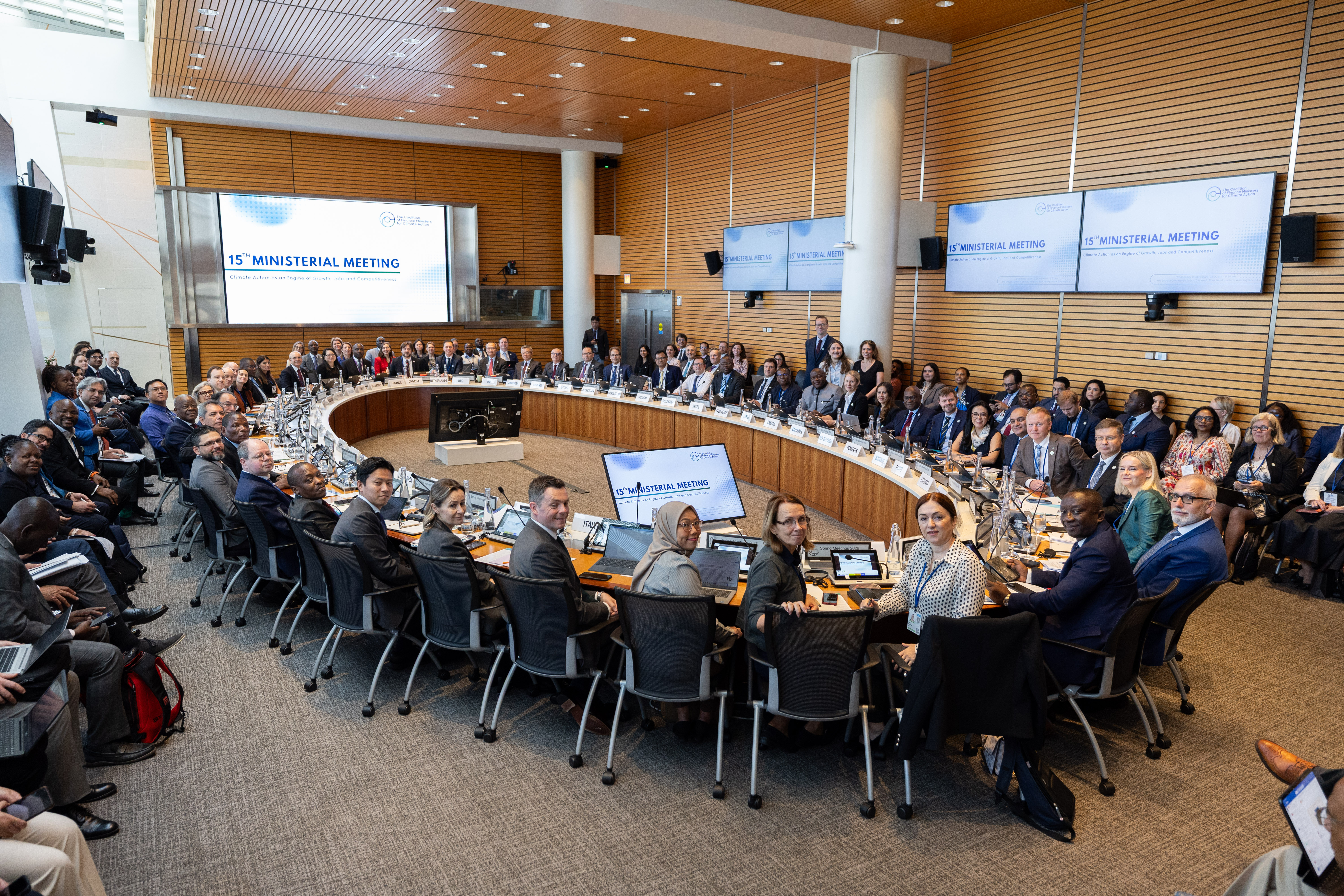
15th Ministerial Meeting of the Coalition of Finance Ministers for Climate Action
Climate Action as an Engine of Growth, Jobs and Competitiveness