



















16th Ministerial Meeting of the Coalition of Finance Ministers for Climate Action

16th Ministerial Meeting of the Coalition of Finance Ministers for Climate Action
Read More

Coalition of Finance Minister events, reports, tools, and highlights 

The Coalition is dedicated to providing insightful news updates on global efforts and progress in country domestic climate action we support


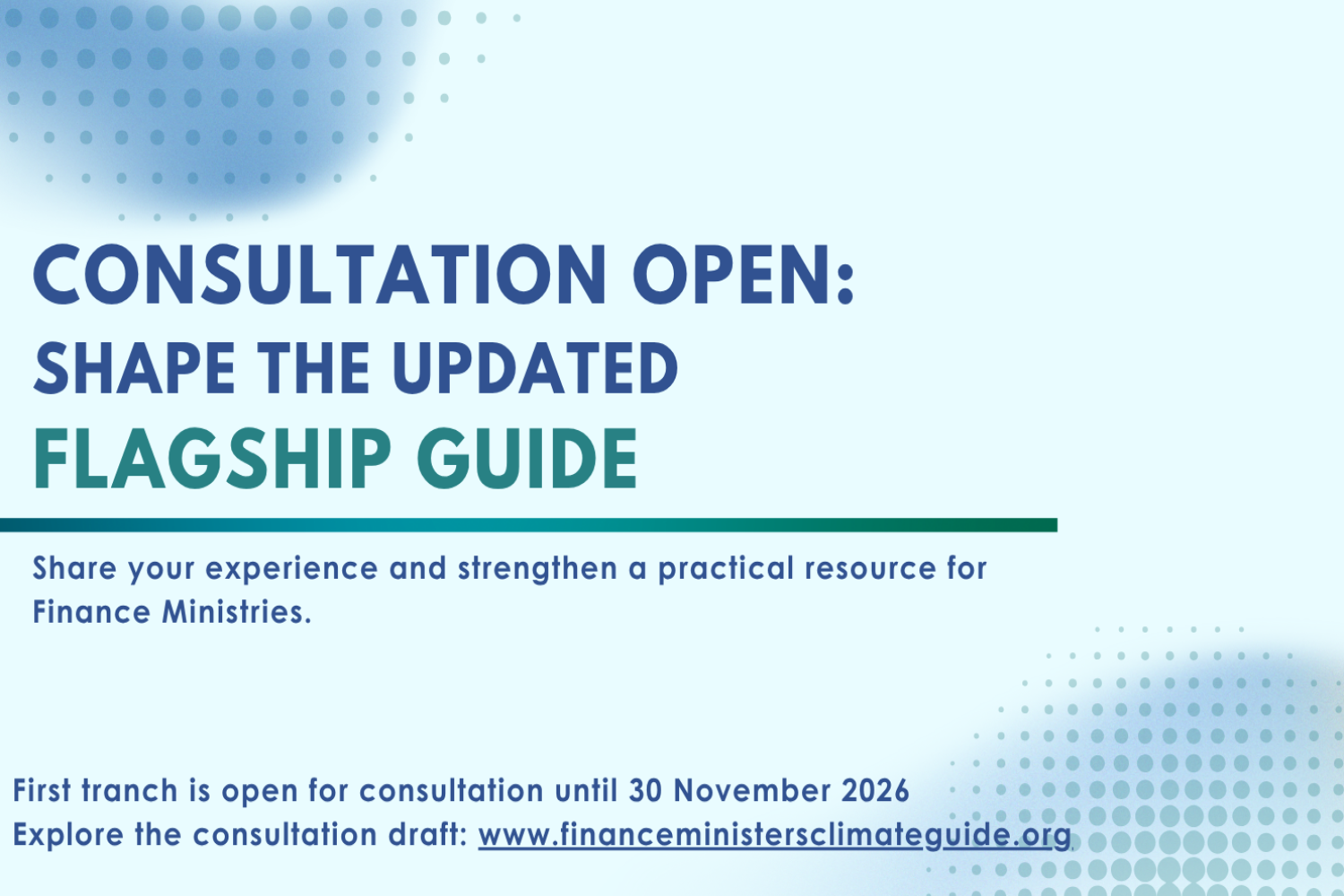
The first Action Areas of the updated Flagship Guide are now open for consultation.

Coalition members and other interested stakeholders are invited to review the drafts and share their feedback, country experience, and implementation lessons to help make the final Guide as practical and useful as possible for Ministries of Finance. 

Contribute through the consultation form

Explore the consultation draft on the interactive website and share your feedback

Consultation until 30 November 2026 


The Network for Greening the Financial System (NGFS) and the Coalition of Finance Ministers for Climate Action (CFMCA) have launched a new joint dialogue platform to deepen knowledge sharing between central banks and finance ministries on the macroeconomic dimensions of climate change and the transition to a low-carbon economy.

Check the previous and upcoming joint events here.


The Coalition’s program in Bangkok brings together ministerial leadership, regional and technical dialogue, and practical exchanges on climate and economic policy and reflects its growing focus on implementation, peer exchange and strengthening the role of Finance Ministries in climate action.
 
Read our main outcomes:

And follow us on LinkedIn for daily updates.


About the Coalition

Finance Ministers hold the keys to accelerating climate action. They are most clearly aware of the risks posed by climate change and recognize how taking action could unlock trillions in investments and create millions of jobs by 2030.

The Coalition of Finance Ministers for Climate Action brings together fiscal and economic policymakers from 100 countries to lead the global climate response and secure a just transition towards low-carbon, resilient development.

104 Member Countries

Member Countries


From Strategy to Impact: Results of the Netherlands’ Co-Chairmanship 2023-2026

June 24, 2026
7

By the Netherlands Finance Ministry

Between 2023 and 2026, the Netherlands helped shape the Coalition of Finance Ministers for Climate Action into a results-driven forum for climate policy leadership. The Dutch Co-Chairmanship introduced the annual Climate Action Statement, strengthened members’ regional engagement, and increased the Coalition’s presence in international fora, including the UN and G20, leaving a legacy of innovation, collaboration, and measurable impact.

Succeeding Finland in April 2023, the Netherlands assumed Co-Chairmanship of the Coalition and worked jointly with Indonesia to move beyond convening and towards delivery and impact. One of the most significant innovations under the Dutch-Indonesian leadership was the introduction and launch of the Climate Action Statement (CAS). First introduced in 2023, the CAS became an annual tradition, including a ministerial statement and an extensive database showcasing members’ climate-related fiscal, financial and economic policies. By 2025, the CAS had grown to include over 500 policy actions from nearly 70 countries, reflecting increased ambition and transparency. To complement this, the Co-Chairs guided the development of the Climate Action Map and forthcoming database, an interactive tool that visualizes country-level climate actions across key policy domains, including taxation, public financial management, and regulatory reform. These tools enhanced accountability, fostered peer learning and supported policy implementation across the Coalition’s growing membership.

The Coalition also evolved to develop and implement comprehensive Strategic Work Programs, most recently setting out a vision for the next three years together with Uganda and Croatia. The new Strategic Work Program 2026-2028 focuses on four strategic and five thematic priorities.

Article content
Strategic Priorities and Working Groups 2026-2028

Over the three-year period, the Netherlands co-chaired seven global ministerial meetings, as well as numerous side events during the IMF–World Bank Spring and Annual Meetings, and four high-level gatherings at UN climate and biodiversity summits in the UAE, Colombia, Azerbaijan and Brazil. These high-level meetings served as platforms for launching key initiatives such as the Joint NDC Support Initiative, and informed practical tools such as 11 technical policy deliverables including a policy note on fossil fuel subsidy reform and on strengthening finance ministries’ capacity and engagement in the NDCs. Further, these ministerial meetings sent strong signals from the finance ministers’ community through the annual Climate Action Statements and the April 2025 Ministerial Outcome Statement.

Article content
Key Results

Beyond global convenings, during the Dutch leadership term, the Coalition prioritized strengthening of regional member engagement, recognizing that climate challenges and solutions are often context-specific. In 2024, the Coalition organized its first-ever regional meetings for Africa and Asia-Pacific. These gatherings in Kampala and Manila brought together ministries from across their respective regions, fostering peer-to-peer learning on adaptation, resilience, and green growth. The success of these events catalyzed further regional exchange in 2025, including in Bangkok, Addis Ababa, Luxembourg, and Lusaka.

At the global level, the Coalition became a central actor in the global climate finance architecture. Through active engagement in G20 working groups under Brazil and South Africa’s presidencies, UNFCCC COP presidencies, and other multilateral forums such as the Circle of Finance Ministers and Africa Climate Summit, the Coalition helped finance ministries to be recognized as essential players in the implementation of global and national climate objectives.

The Coalition also focused on responding to members’ needs on capacity building. In 2023, the Coalition presented the initial comprehensive Guide on Strengthening the Role of Ministries of Finance in Driving Climate Action. Accompanying the Guide, the Coalition launched a pilot of the rapid self-assessment tool, the Capability Assessment Framework, equipping finance ministries with the tools to assess and enhance their climate readiness. Further,  the Coalition's flagship macroeconomic analysis initiative, originated from the Helsinki Principe 4 workstream, developed tools and fostered exchange among members on mainstreaming climate considerations into economic policies, with a strong emphasis on macroeconomic modelling and improving climate-responsive fiscal planning.

As the Netherlands handed over the Co-Chair role to Croatia in April 2026, it leaves behind a Coalition that is larger, more cohesive, and more impactful. During its tenure, the Netherlands contributed to strengthening its strategic direction, institutional development, and the role of finance ministries in the transition to a resilient, net-zero global economy.

Read more in the report ‘Results of the Netherlands Co-Chairmanship 2023-2026’

From Paper to Practice: How Finance Ministries Are Advancing Coherent Climate Policy

From Paper to Practice: How Finance Ministries Are Advancing Coherent Climate Policy


Coherent climate policy packages are essential to achieving climate and development objectives, with Ministries of Finance playing a key role in their design and implementation.

Ministries of Finance (MoFs) face increasingly complex questions about the direct and indirect implications of the green and resilient transition. Recent geopolitical developments in key energy-producing regions have added to volatility in global energy markets and reinforced concerns about energy security. At the same time, shifting towards low carbon economies offers transition and resilience enhancing economic opportunities to boost growth, create jobs, and enhance energy security. Building effective climate policy packages requires robust and credible answers—grounded in sound economic analysis—that clearly set out the risks and opportunities of different policy pathways. As governments seek to accelerate decarbonization while maintaining growth and fiscal stability, MoFs are uniquely positioned at the center of this challenge, shaping economic strategy, allocating public resources, and mobilizing finance at scale.

Against this backdrop, the Coalition of Finance Ministers for Climate Action recently published its report “How Ministries of Finance Can Support Coherent Climate Policy Packages”, highlighting how coordinated, multi-instrument approaches can deliver both climate and economic outcomes. To bring these insights into practice, the Coalition convened a public webinar bringing together senior officials from ministries of finance, international organizations, and research institutions. The discussion explored how coherent policy packages can drive investment, strengthen fiscal resilience, and support economic competitiveness, while underscoring the pivotal, yet still underutilized, role of finance ministries in climate action.

Article content
Report launched in February 2026

(Read the full report here.)

Event overview

The webinar focused on how Ministries of Finance can operationalize coherent climate policy packages under conditions of fiscal constraint and rising climate risk. Climate change was framed as a macroeconomic and fiscal challenge, with implications for public finances, economic stability, and long-term growth. Delivering effective outcomes was linked to aligning fiscal, regulatory, financial, and investment measures within a coherent policy framework, with Ministries of Finance playing a central role in managing trade-offs and ensuring consistency across government. Emphasis was placed on the use of analytical tools to inform policy design, support sequencing, and enable adjustment over time.

Keynote

Patrick Lenain (Council on Economic Policies), lead author of the report, highlighted that climate change remains insufficiently integrated into the core mandate of many Ministries of Finance, despite its material implications for fiscal sustainability and economic performance. He emphasized that Ministries of Finance already possess a broad set of policy levers and analytical tools, and that delays in engagement are often driven more by perceived constraints than by actual limitations.

Article content
Governments rarely rely on carbon taxes stand-alone

He underscored that effective climate action depends on well-coordinated, multi-instrument policy packages rather than reliance on single measures. A pragmatic and iterative approach was emphasized, with policy development proceeding alongside ongoing evaluation and refinement. The importance of sequencing reforms and aligning climate and economic objectives was also highlighted.

Article content
Model simulation suggests large impact on emissions

Country Perspectives

Uganda

June Nyakahuma (Ministry of Finance, Planning and Economic Development, Uganda) highlighted the role of institutional and legal frameworks in supporting coherent climate policy, including the Climate Change Act. Coordination between the Ministry of Finance, the National Planning Authority, and the Ministry of Water and Environment enables the integration of climate considerations into planning and budgeting. Fiscal instruments, including fuel taxes and environmental levies, are used to support climate objectives. Analytical capacity is strengthened through collaboration with international organizations, while the Climate Finance Unit supports the development and management of climate finance frameworks.

Ecuador

Paula Suarez (Ministry of Economy and Finance, Ecuador) emphasized the need for a pragmatic, adaptive approach to climate policy in the context of fiscal constraints and structural economic conditions. The use of a diverse set of policy instruments, strengthened coordination within and across government, and attention to distributional impacts were identified as key elements in advancing reform. The importance of understanding private sector exposure to climate risks was highlighted, alongside the role of international support, including from the IMF and World Bank, in enabling major reforms such as fossil fuel subsidy reform.

Nigeria

Temitope Akinyemi (Ministry of Finance, Nigeria) highlighted the fiscal and economic implications of climate change, including impacts on agriculture, infrastructure, and energy systems. Climate-related disruptions increase pressure on public expenditure, while transition risks affect revenues from oil and gas. The Ministry of Finance plays a central role in coordinating climate-related investments and mobilizing finance, including through instruments such as green bonds and carbon finance mechanisms, supported by international partnerships.

Link to video.

Link to discussion overview.

The Coalition at the NFGS Annual Plenary: adaptation, nature risk and climate scenarios as global cooperation tightens

March 11, 2026

Pretoria, South Africa - Central banks and financial supervisors gathered in Pretoria for the Annual Plenary Meeting of the Network for Greening the Financial System (NGFS), where participants advanced discussions on climate and nature‑related financial risks, with a strong focus on adaptation, nature integration, climate scenarios and monetary policy in a hotter world.


meeting pretoria nfgs

The meeting, held on 9–10 March 2026 and hosted by the South African Reserve Bank (SARB), was chaired by NGFS Vice Chair and SARB Deputy Governor Fundi Tshazibana. It brought together more than 180 representatives from central banks and supervisory authorities across 76 countries, reflecting the continued expansion of the NGFS and the growing demand for its technical work.

In her opening remarks, NGFS Chair Sabine Mauderer, First Deputy Governor of the Deutsche Bundesbank, stressed that while international cooperation was under increasing pressure, climate change remained a physical reality with material financial consequences. She emphasized that the NGFS was responding by strengthening its strategy, sharpening its analytical tools and reinforcing cooperation across jurisdictions.

Discussions during the plenary focused on translating analysis into practical solutions. Members examined how improved data and analytics could support climate adaptation and economic resilience, and how nature‑related risks, including the value of ecosystem services such as water, could be more systematically incorporated into supervisory practices. Participants also exchanged views on the next update of short‑term climate scenarios, aimed at better capturing near‑term macro‑financial risks, and on the implications of climate change for monetary policy, including its effects on food and energy inflation.

The programme featured contributions from global leaders, including Elizabeth Maruma, Executive Director of the United Nations Environment Programme Finance Initiative (UNEP FI), and Frank Elderson of the European Central Bank, who underlined the importance of international cooperation and evidence‑based approaches to managing climate and nature risks.

At the plenary, NGFS members agreed on three strategic priorities for 2026–2027: remaining a technical incubator for innovative approaches; providing scenario expertise; and strengthening capacity building to support practical implementation across diverse institutional and regional contexts. The NGFS also announced the introduction of regional groups to further enhance inclusiveness and responsiveness within its growing membership.

The Coalition of Finance Ministers for Climate Action participated actively in the Pretoria discussions, contributing to exchanges on capacity building, delivery and international cooperation. The Coalition’s engagement reinforced the importance of alignment between ministries of finance, central banks and supervisors in translating analytical work into concrete policy action and strengthening macro‑financial resilience. The exchange built on the Platform’s launch in São Paulo in November and the technical workshop held in London in January, highlighting the importance of sustained cooperation between ministries of finance, central banks and supervisors to support practical delivery on climate and nature‑related financial risks.

Concluding the meeting, Vice Chair Fundi Tshazibana highlighted that while climate and nature‑related risks were complex, they were not insurmountable, and that sustained collaboration and proactive engagement remained essential to building a more resilient and sustainable financial system.

Launch of a webinar series on Border Carbon Adjustments (BCAs)

March 11, 2026

The Coalition of Finance Ministers is launching a new webinar series under HP3 to explore the design, implementation and impact of carbon border adjustments (BCAs), i.e. charges on embodied carbon in imports. 

While carbon pricing policies are widely acknowledged as a powerful tool in realigning economic incentives and reducing emissions, they often raise questions around competitiveness and carbon leakage. BCAs can help to address these issues. However, while BCAs may be conceptually widely supported, in practical terms, they present a largely unchartered and emerging area of policy practice. Countries seeking to enact BCAs face complex trade-offs in design and implementation, while trading partners are increasingly looking to understand the impact of BCAs on their own economies and how best to adjust and adapt. 

This webinar series is particularly timely given the recent implementation of the first BCA by the European Union in January 2026, and given that the topic of BCAs can be expected to feature prominently during the UNFCCC's trade-related discussions in 2026.

About the Series

Objectives

  • Disseminate and discuss available knowledge among members regarding:
    • the rationale, design and implementation of BCAs
    • the mechanics of existing and planned BCAs
    • tools and methods to evaluate the impact of a BCA on trading partners
  • Share country experiences in designing and implementing BCAs and, for trading partners, in determining the most appropriate policy response.
  • Inform ongoing HP3 work and collective knowledge within the Coalition on BCAs.

Please note that the series intended to provide a forum for practical and technical discussion, and will not facilitate or engage in negotiations.

Series Structure

  • The webinar series will be hosted by the Coalition from March to May 2026. Each session will be 1 hour in duration and will be open to Coalition members and partners.
  • Each webinar will feature a thematic presentation by an institutional or knowledge partner on the topic, country case studies, or both, followed by a structured discussion and Q&A.
  • A brief summary note will be prepared at the end of the series, summarising lessons learned and case studies of different approaches.

Provisional seminar dates are as follows:

  • Webinar 1: Introduction to BCAs – Tuesday, March 17, 2026 at 9:00 a.m. ET
  • Webinar 2: Mechanics of Existing BCAs – Tuesday, April 7, 2026 at 9:00 a.m. ET
  • Webinar 3: Modeling the Impacts of CBAM – Tuesday, April 28, 2026 at 9:00 a.m. ET
  • Webinar 4: Policy Responses to the EU CBAM — Climate, Fiscal, and Competitiveness Implications – Tuesday, May 26, 2026 at 9:00 a.m. ET

If you would like to contribute to this series, please email Alpa Shah (supporting Institutional Partner) at ashah@imf.org.