























16th Ministerial Meeting of the Coalition of Finance Ministers for Climate Action

16th Ministerial Meeting of the Coalition of Finance Ministers for Climate Action
Read More

Coalition of Finance Minister events, reports, tools, and highlights 

The Coalition is dedicated to providing insightful news updates on global efforts and progress in country domestic climate action we support


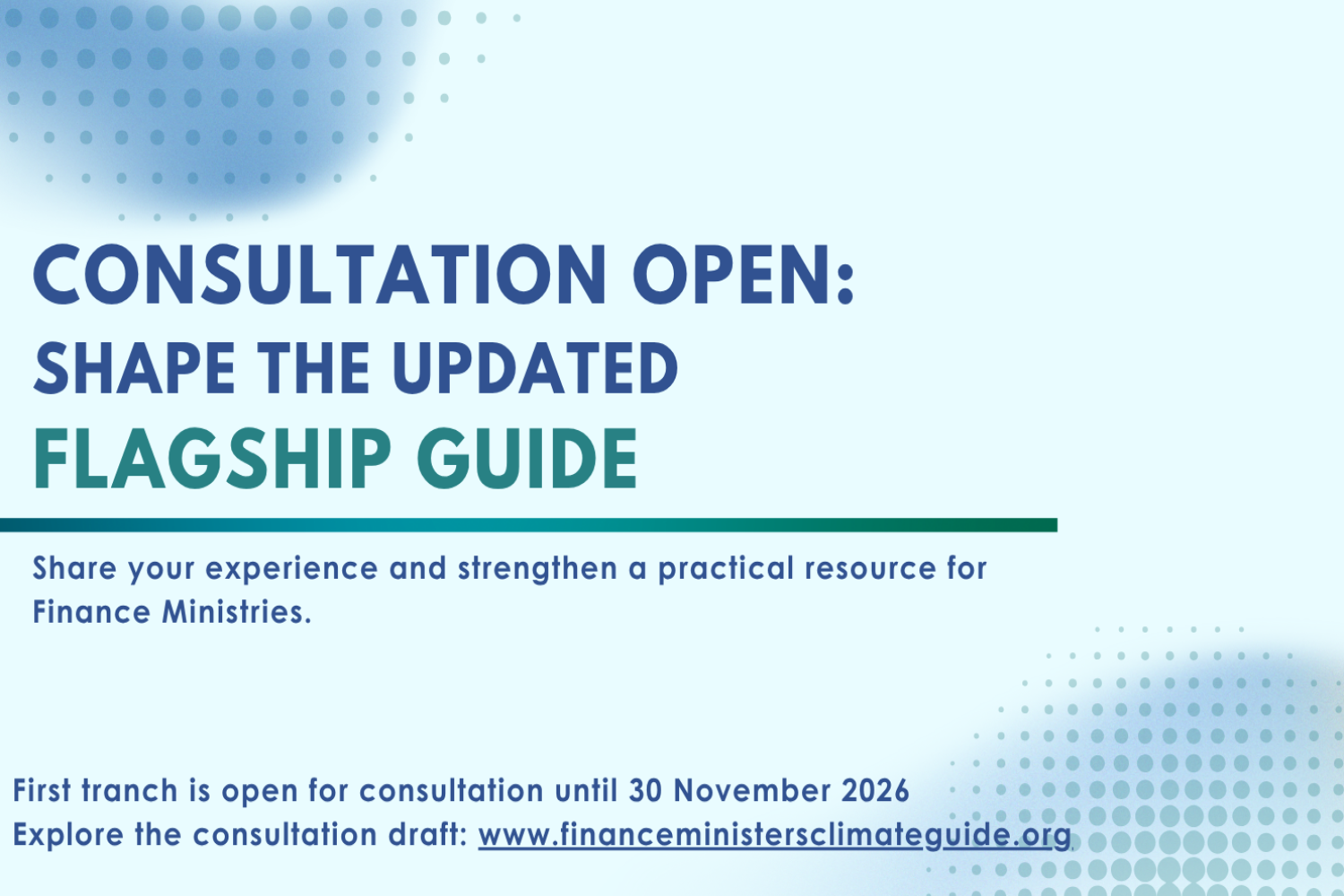
The first Action Areas of the updated Flagship Guide are now open for consultation.

Coalition members and other interested stakeholders are invited to review the drafts and share their feedback, country experience, and implementation lessons to help make the final Guide as practical and useful as possible for Ministries of Finance. 

Contribute through the consultation form

Explore the consultation draft on the interactive website and share your feedback

Consultation until 30 November 2026 


The Network for Greening the Financial System (NGFS) and the Coalition of Finance Ministers for Climate Action (CFMCA) have launched a new joint dialogue platform to deepen knowledge sharing between central banks and finance ministries on the macroeconomic dimensions of climate change and the transition to a low-carbon economy.

Check the previous and upcoming joint events here.


The Coalition’s program in Bangkok brings together ministerial leadership, regional and technical dialogue, and practical exchanges on climate and economic policy and reflects its growing focus on implementation, peer exchange and strengthening the role of Finance Ministries in climate action.
 
Read our main outcomes:

And follow us on LinkedIn for daily updates.


About the Coalition

Finance Ministers hold the keys to accelerating climate action. They are most clearly aware of the risks posed by climate change and recognize how taking action could unlock trillions in investments and create millions of jobs by 2030.

The Coalition of Finance Ministers for Climate Action brings together fiscal and economic policymakers from 100 countries to lead the global climate response and secure a just transition towards low-carbon, resilient development.

104 Member Countries

Member Countries


Launch of Driving a coordinated whole-of-economy transformation workstream (TP1)

June 29, 2026

The Coalition of Finance Ministers for Climate Action convened during the London Climate Action Week to formally launch the Thematic Priority 1 workstream of its 2026–2028 strategic work program: From Commitments to Action - Driving a Coordinated Whole-of-Economy Transformation. The event brought together finance ministry officials from Uganda, Spain, Australia, Denmark, Finland, and Croatia to address a long-standing challenge for policymakers: the persistent lack of coordination in translating climate policies and strategies into concrete and effective action.

Three Key Takeaways

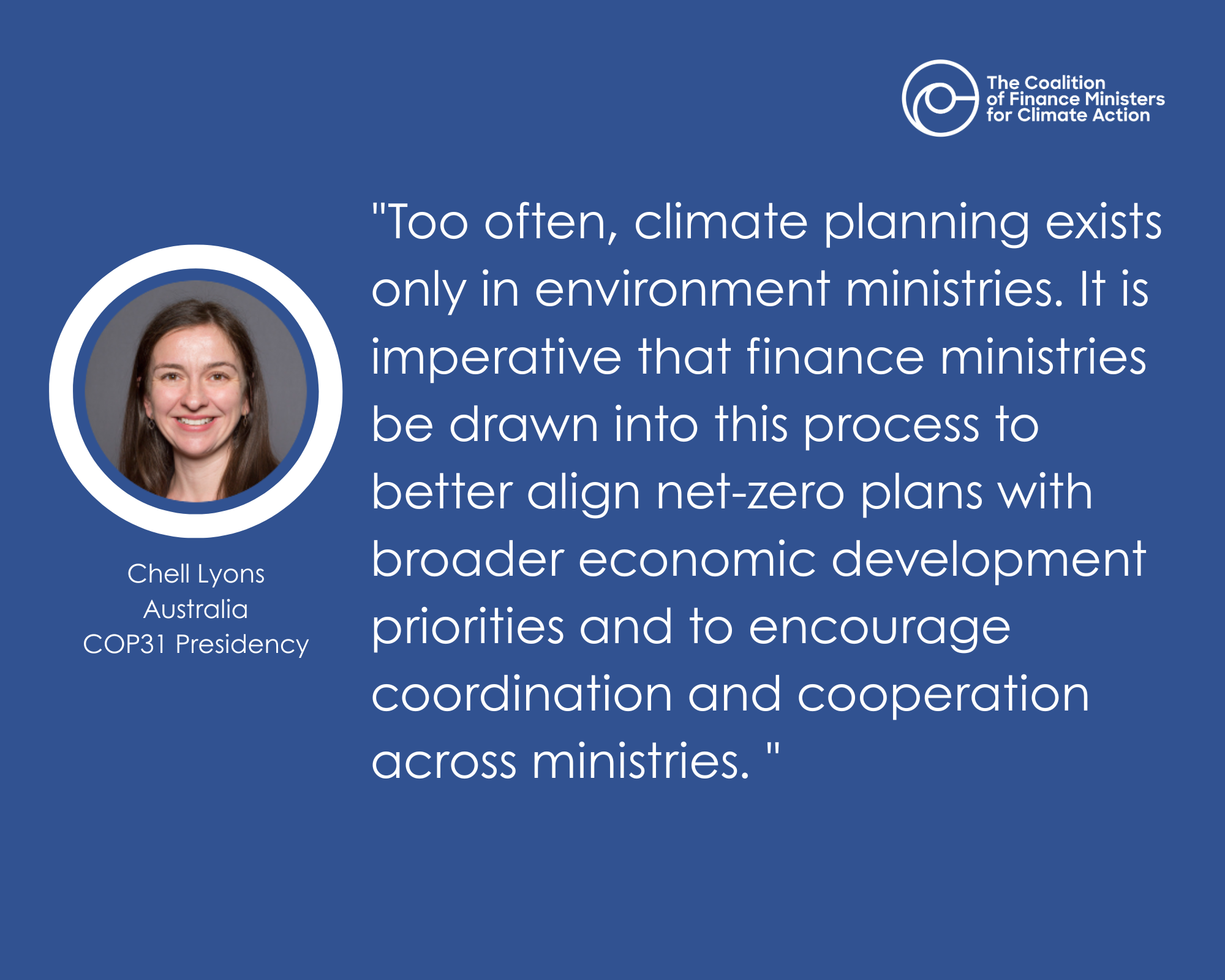
1. Finance ministries are key actors in whole-of-economy transformation - as coordinators and risk managers. A whole-of-economy transformation cannot be driven solely by the environment or line ministries. It demands the institutional authority, fiscal tools, regulatory levers, and cross-government reach that only finance ministries possess. Their role spans setting macroeconomic frameworks, allocating public investment, creating incentives, and managing the risks posed by climate change. From stranded assets and transition shocks to cross-border carbon fees and the mounting costs of extreme weather events, climate risk is a macro critical issue. Finance ministries are the custodians of this exposure, and their early engagement in climate planning is essential to ensuring that national strategies are not only ambitious but also economically sound and fiscally sustainable. 
 

chell

2. Coordination must be institutionalized and built on what already exists. Driving a coordinated transformation across an entire economy requires more than political will; it requires sustainable institutional structures. Effective coordination must work horizontally, across different line ministries and vertically, between national governments and the subnational authorities responsible for delivery on the ground. Critically, each country arrives at this challenge with its own institutional history, existing tools, and sectoral frameworks. Finance ministries should leverage and integrate what line ministries have already built, not duplicate it. Countries shared how they have done so by embedding climate into budget cycles, establishing Climate Finance Units as the connective tissue between sectoral action and national fiscal planning, and moving from isolated project spending to integrated, program-based approaches.

3. Finance ministries must own the climate narrative, not just the purse strings. For whole-of-economy transformation to work, finance ministries must actively shape how climate action is framed: as a structural economic opportunity. Country Climate and Development Reports (CCDRs) are a powerful tool in this regard, linking climate objectives to growth trajectories and investment opportunities in language that resonates across government. Finance ministries that engage early, set realistic budgets, assess and manage risks and champion cross-sectoral investment pipelines are better placed to build the political coalitions that whole-of-economy transformation demands and to ensure that the transition works for every part of the economy.

What Comes Next

The TP1 launch event was the beginning of a conversation, not an endpoint. In the months ahead, the workstream will deliver a series of webinars on CCDRs and Climate Finance Units, sharing practical evidence on how to establish and sustain them across different country contexts. Peer exchange events will carry the conversation forward, with a focus on practical, replicable solutions. Participants also committed to continuing the conversation on closing coordination gaps in climate policy execution, integrating climate into budget processes, developing real-time expenditure tracking tools, and replacing fragmented project spending with program-based frameworks. International collaboration was identified as essential: no country can build the analytical capacity and institutional knowledge needed for whole-of-economy transformation alone. Participants called for deeper international cooperation on macroeconomic modeling and greater support for Least Developed Countries, which face the steepest barriers to accessing climate finance and technical assistance.

As TP1 workstream moves to implementation, the Coalition of Finance Ministers for Climate Action will convene member countries, facilitate knowledge exchange, and develop practical guidance for finance ministries to translate climate commitments into coordinated fiscal action.

First European Regional Meeting of the Coalition of Finance Ministers for Climate Action

February 04, 2026

From 1-3 December 2025 in Luxembourg, nearly 50 participants from European member countries and institutional partners came together to strengthen collaboration on climate-related financial and economic priorities.

Key takeaways from our discussions:

Members reflected on 2025’s major developments – from COP30 outcomes to evolving climate finance discussions – and outlined priorities for 2026.

Countries shared progress on sustainable finance regulations and explored opportunities for transition finance and enhanced international collaboration.

We examined how rising defense expenditures intersect with climate commitments, identifying synergies for resilience and energy security.

Finance ministries discussed their role in delivering the updated NDCs and strategies to overcome financial and institutional barriers.
 

eur
We discussed the forthcoming update of the Coalition’s Flagship Guide by COP31 to create stronger links with industrial policy, trade, and competitiveness, and integrate nature, biodiversity, adaptation, and resilience.

This meeting marked a significant step in enhancing member engagement, sharing Europe-specific insights, and shaping the Coalition’s work for 2026 and beyond.

Africa’s Finance Ministers Launch Pan-African Forum to Drive Climate-Responsive Economic Transformation

February 04, 2026

From 16–18 December 2025, the Coalition of Finance Ministers for Climate Action (CFMCA) brought together approximately 100 representatives from around 30 African Ministries of Finance in Lusaka to chart a new direction for climate‑economic cooperation.

The regional event concluded with the following outcomes:

  • Ministers launched the African Finance Ministers’ Platform, agreed on interim leadership and a 2025–2027 Roadmap, and aligned on integrating climate and nature risks into fiscal planning and investment decisions.
  • Countries advanced joint work on climate finance platforms, debt–climate linkages, carbon markets, natural capital accounting, and green jobs, and strengthened shared African positions on concessional finance, debt‑for‑climate instruments, and adaptation needs.

The meeting also secured new commitments for peer learning, technical assistance, and joint analytical work, setting a clear path toward the March 2026 Africa Finance Ministers’ Meeting. The Coalition thanks the Ministry of Finance and National Planning of Zambia, participating Ministries, and partners for their leadership and support.

Press: https://nilepost.co.ug/business/311069/africas-finance-ministers-launch-pan-african-forum-to-drive-climate-responsive-economic-transformation

https://www.finance.go.ug/media-center/news-and-updates/launch-pan-african-finance-ministers-forum-climate-action-lusaka 

Joint Dialogue Platform NFGS and Coalition

February 04, 2026

Last week, the Network for Greening the Financial System (NGFS) and the Coalition of Finance Ministers for Climate Action (CFMCA) held the first joint workshop in London, following the launch of our Joint Dialogue Platform at COP30. With over 100 participants in attendance, both online and in person, the workshop provided members with an opportunity to exchange concrete experiences, modelling practices, and emerging needs from across institutions. 
group
The workshop focused on three core areas:
• Physical climate risk assessment: aligning approaches across central banks and finance ministries
• Macroeconomic policy design under climate shocks: from growth and inflation impacts to fiscal sustainability
• Sustainable financing frameworks: strengthening tools for investment planning and transition policies

The workshop underscored a shared commitment to deepen collaboration and strengthen joint analytical work to support decision-making in both Ministries of Finance and central banks.

For those interested, the Coalition has made available a range of analytical resources for Ministries of Finance, including our searchable Compendium of Practice and NGFS contributions:
1- Main report summarizing analytical tools relevant to pressing questions MoFs face:
https://lnkd.in/epbdpauK
2- NGFS contributions to the Coalition’s searchable Compendium of Practice on analytical tools for climate action:
Macro modelling handbook:
https://lnkd.in/emq2_jDe
3- Approach to assessing physical climate risks:
https://lnkd.in/ey_7HE8K
4- Approach to assessing short-term implications of climate change:
https://lnkd.in/eyJmZzM2

Discussion Note: From Promise to Action: Scaling Up Climate Finance to $1.3T

December 04, 2025

From Promise to Action: Scaling Up Climate Finance to $1.3T


Post-Ministerial Discussion following the 14th Ministerial Meeting 

Discussion Note

Managing over US$30 trillion in public expenditures, more than one-third of global GDP, Ministries of Finance hold the fiscal, regulatory, and policy levers needed to direct resources toward development and climate priorities. With this influence, they can unlock the scale of global investment required to address climate change, funding that must rise and be sustained at a minimum of 2–5% of global GDP annually.

Recognizing the influence and role that Ministries of Finance can play in scaling up climate action, the Coalition of Finance Ministers for Climate Action organized a technical post-ministerial event to discuss scaling up climate finance, managing physical climate risks, and deploying market-based financing mechanisms. The discussions between member countries and institutional partners reflected a growing recognition of the evolving role of Ministries of Finance in climate policy, highlighting the need to move decisively from ambition to action and to embed climate considerations within core fiscal and economic decision-making processes.

Participants acknowledged that public finance can serve as a catalyst for climate investments, but private finance is essential to scale them. Participants also recognized that proactive investment today could help avoid greater costs and higher debt burdens in the future.

A critical point raised was the need to close the gap between the Ministries of Finance and the Ministries of Environment. Ministries of Finance are responsible for managing public funds and driving economic growth, while environment ministries often handle concessional finance and focus on environmental priorities, climate targets, and policies. Bridging the gap between these ministries is essential for efficiently utilizing scarce concessional capital and ensuring that climate policies are integrated into broader economic strategies.

This note is organized around three key takeaways from the meeting. Additional insights captured during the facilitated breakout sessions and plenary segment are also reflected.

Takeaway 1: Country-led, politically anchored platforms must be tailored to national contexts.

Country platforms are increasingly recognized as valuable mechanisms for translating plans into tangible climate and development outcomes, coordinating stakeholders, mobilizing finance, and enhancing the efficiency and effectiveness of financial utilization. They serve as operational structures to implement climate actions aimed at adaptation, resilience, and a just transition within communities and at the macroeconomic level. Country platforms are expected to be funded by domestic and global sources including governments, the private sector, and multilateral institutions. One of the core functions of these platforms is to map public, private, and concessional finance flows, identifying gaps and leveraging investment opportunities. This ensures alignment with national priorities and planning instruments, such as Nationally Determined Contributions (NDCs) and National Adaptation Plans (NAPs). Participants emphasized that there is no “one-size-fits-all” model: platforms illustrate coordination in practice, but each country may establish a structure suited to its institutional context and domestic decision-making processes. Some countries have established dedicated platforms (e.g., Brazil and Egypt) while others have integrated similar functions into existing governance structures (e.g., Denmark and the United Kingdom). Regardless of form, platforms must be politically owned and domestically led, ensuring national leadership in design and implementation. Transparent reporting and disclosure are also crucial for maintaining credibility with investors, donors, and citizens.

Key Considerations for Ministries of Finance

  • Lead or strengthen country-level coordination mechanisms for climate policies  to ensure alignment with domestic strategies and priorities, planning instruments, and fiscal frameworks.
  • Reframe climate action as a fiscal opportunity within the platform by identifying measures to unlock new sources of revenue and investment (e.g., reducing fossil fuel subsidies to free up fiscal space for platform-prioritized investments) and without diverting resources from other development priorities.
  • Use the platform to identify priority investments, sectors, and reforms grounded in Nationally Determined Contributions (NDCs), Long-term Strategies (LTS), National Adaptation Plans (NAPs), and National Transition Plans (NTPs), to provide a coherent demand signal to public and private financiers.
  • Integrate climate targets into investment screening, budget planning, and debt management to ensure platform priorities are reflected in actual resource allocation.


Takeaway 2: Ministries of Finance require more effective tools and data to assess systemic climate risks and engage the private sector through policies such as mandatory insurance.

Physical climate risks are fundamentally a macroeconomic issue with far-reaching impacts on livelihoods, businesses, and fiscal sustainability. Countries globally face significant data limitations, which pose challenges for analysis, alongside building effective macro-economic models and analytical tools. While there has been progress in mainstreaming mitigation policies into core functions such as tax policy and budgeting, progress on adaptation remains slow. This is primarily attributed to the insufficient availability of climate risk data and challenges in quantifying adaptation costs and investments. Participants highlighted that a lack of reliable data affects the quality of risk assessments and the overall understanding of adaptation needs. Participants also discussed the need to shift towards a system-based approach for risk management (i.e., moving beyond the protection of individual assets to safeguarding interconnected systems, such as transport networks linked to hospitals). This approach, while more effective, is also more costly and requires stronger buy-ins from the private sector. Mandatory insurance policies for businesses were highlighted as a potentially effective mechanism for risk transfer (e.g., in Italy). This involves gradually introducing a mandatory insurance scheme, supported by a state-backed reinsurance fund to cover a portion of claims, and requiring companies to insure assets against climate-related disasters. However, the challenge of weak or non-existent insurance sectors in some developing countries was noted, raising questions about alternative mechanisms for addressing these issues. Ultimately, Ministries of Finance will need to strengthen their data systems and create regulatory and financial conditions that facilitate risk-sharing.

Key Considerations for Ministries of Finance

  • Invest in capacity building, data collection, and analysis for integrating climate risk data into macroeconomic modeling, fiscal planning, and public investment appraisal processes. Promote systems-based approaches to asset management by revising investment appraisal criteria and requiring resilience considerations in project preparation and procurement.
  • Adopt insurance, risk-financing, and other risk-transfer mechanisms to reduce exposure to climate risks (e.g., sovereign risk pools, catastrophe bonds, and contingent credit lines).
  • Develop strategies to incentivize private sector adaptation investment through tax incentives, blended finance instruments, climate-resilient procurement rules, and disclosure requirements. 

Takeaway 3: Effective carbon pricing requires phased implementation, equity safeguards, and international coordination to scale impact.

Carbon pricing instruments, including carbon taxes, carbon border adjustments, and market-based mechanisms such as emissions trading schemes, were identified as critical tools for reducing greenhouse gas emissions. There was broad agreement that carbon pricing remains one of the most efficient mechanisms for driving emission reductions, but that country’s context must be considered in its design. The challenges associated with carbon pricing were also acknowledged, with participants noting that implementation is often a complex process. One of the main drawbacks discussed was the regressive nature of carbon pricing, which can disproportionately impact lower-income households and emission-intensive trade-exposed industries, depending on the scope of fuels or emissions covered. As such, there was consensus that carbon pricing should be designed to balance fiscal and environmental effectiveness with equity, with prudent use of additional fiscal space to provide support to vulnerable households, businesses, and sectors as well as incentives for clean investment (e.g., Ireland, Germany, Netherlands, and Sweden). International coordination and gradual implementation were deemed essential for ensuring the credibility and sustainability of carbon pricing mechanisms. Participants agreed that building confidence through gradual implementation and transparent market rules can help countries transition towards broader, more connected carbon pricing frameworks. 

Key Considerations for Ministries of Finance

  • Recycle revenues back into the economy through investments or compensation mechanisms for vulnerable households to ensure fiscal and social considerations are met.
  • Balance environmental objectives with the need to maintain economic competitiveness by assessing potential impacts on sectors and designing policies that mitigate negative effects (e.g., providing incentives for clean investments).
  • Establish clear signaling strategies for future price increases to foster market confidence and facilitate smooth transitions.
  • Link carbon pricing systems to enhance credibility, scalability, and price convergence – and simplify cross-border trade and investment.

Download here the discussion note