



























Coalition of Finance Minister events, reports, tools, and highlights 

The Coalition is dedicated to providing insightful news updates on global efforts and progress in achieving climate action goals

New global initiative to deepen knowledge exchange between central banks and finance ministries to manage climate risks.

The Network for Greening the Financial System (NGFS) and the Coalition of Finance Ministers for Climate Action (CFMCA) have launched a new joint dialogue platform to deepen knowledge sharing between central banks and finance ministries on the macroeconomic dimensions of climate change and the transition to a low-carbon economy.

Discover more here.

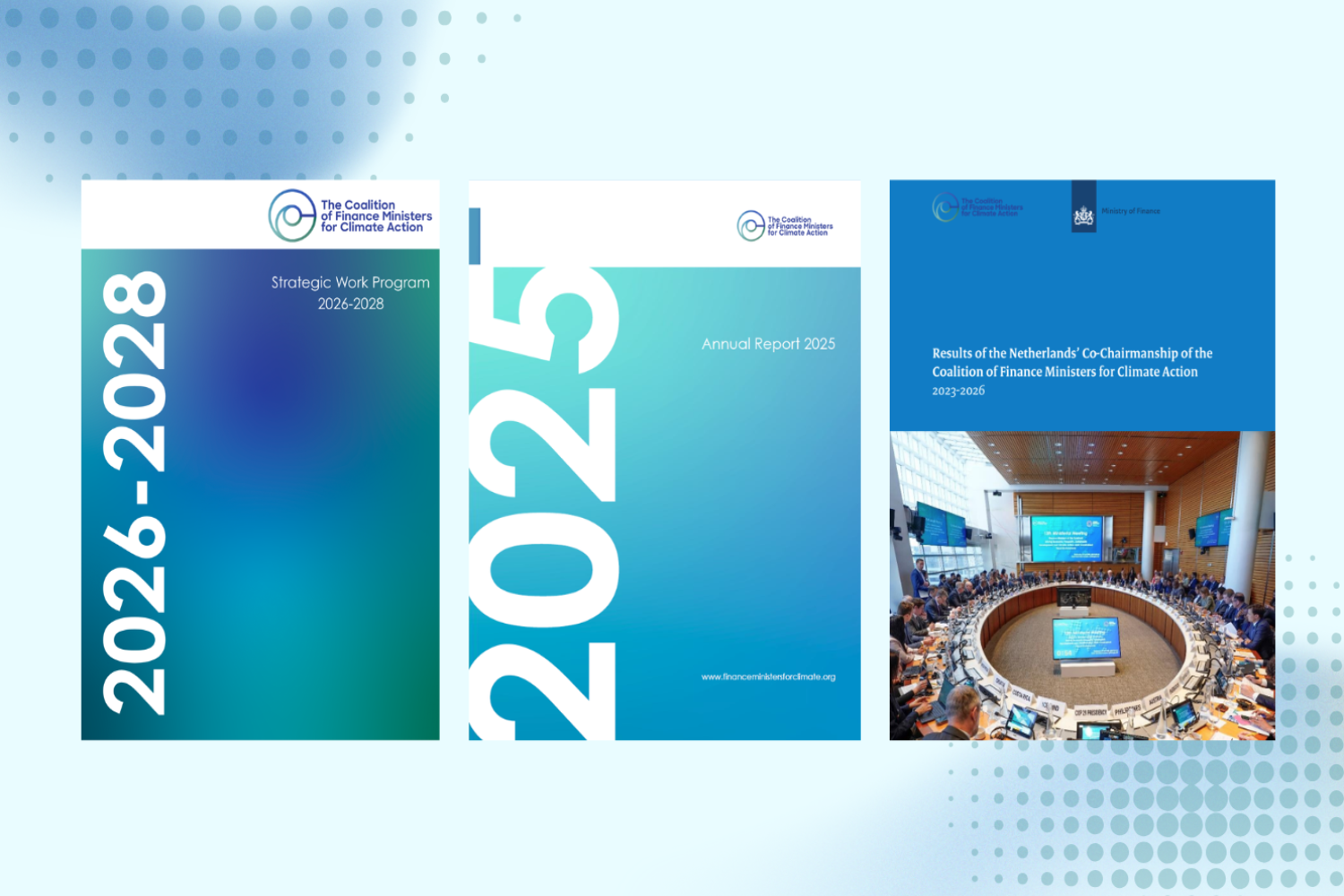
How Ministries of Finance Can Build Capabilities for Economic Analysis and Modeling to Drive Green and Resilient Transitions - October 2025

Economic Analysis and Modeling Tools to Assist Ministries of Finance in Driving Green and Resilient Transitions - November 2025

Read the reports

Climate Action Statement 2025 and Climate Action Map

Over 500 climate policies by finance ministries worldwide show the economic benefits of climate action. The latest edition of the Climate Action Statement, featuring data from nearly 70 countries, demonstrates that finance ministries are driving economic growth, competitiveness, and resilience through their climate ambitions.

Read it now

About the Coalition

Finance Ministers hold the keys to accelerating climate action. They are most clearly aware of the risks posed by climate change and recognize how taking action could unlock trillions in investments and create millions of jobs by 2030.

The Coalition of Finance Ministers for Climate Action brings together fiscal and economic policymakers from 100 countries to lead the global climate response and secure a just transition towards low-carbon, resilient development.

Learn More

The Helsinki Principles

The six Helsinki Principles guide the Coalition's commitment to #ClimateAction

Helsinki Principle 1: Align Policies with the Paris Agreement

Align our policies and practices with the Paris Agreement commitments
Read More

Helsinki Principle 2: Share Experiences & Expertise

Share our experience and expertise with each other in order to provide mutual encouragement and promote collective understanding of policies and practices for climate action
Read More

Helsinki Principle 3: Promote Carbon Pricing Measures

Work towards measures that result in effective carbon pricing
Read More

Helsinki Principle 4: Mainstream Climate in Economic Policies

Take climate change into account in macroeconomic policy, fiscal planning, budgeting, public investment management, and procurement practices
Read More

Helsinki Principle 5: Mobilize Climate Finance

Mobilize private sources of climate finance by facilitating investments and the development of a financial sector which supports climate mitigation and adaptation
Read More

Helsinki Principle 6: Engage in NDC Development

Engage actively in the domestic preparation and implementation of Nationally Determined Contributions (NDCs) submitted under the Paris Agreement
Read More

Workstream: Adaptation

Adapting to the risks of climate change to moderate potential damages or to benefit from opportunities
Read More

Workstream: Green and Just Transition

Combining environmental sustainability with social justice must be considered in any effort to build a more sustainable future for everyone
Read More

Workstream: Nature

Prioritizing nature-based solutions in budgeting decisions is imperative for the Ministries of Finance to mitigate environmental impact
Read More

100 Member Countries


Member Countries


Events

View recent and upcoming Coalition events, including workshops, webinars and meetings

NGFS and the Coalition of Finance Ministers Strengthen Collaboration on Climate with Launch of Joint Dialogue Platform at COP30

November 21, 2025

New global initiative to deepen knowledge exchange between central banks and finance ministries to manage climate risks.


São Paulo, Brazil – November 7, 2025 — The Network for Greening the Financial System (NGFS) and the Coalition of Finance Ministers for Climate Action (CFMCA) have launched a new joint dialogue platform to deepen knowledge sharing between central banks and finance ministries on the macroeconomic dimensions of climate change and the transition to a low-carbon economy.


Climate change and the low-carbon transition are reshaping the macroeconomic and financial landscape in ways that affect the missions of both central banks and finance ministries. In the face of intensifying physical climate risks, evolving transition dynamics, and growing demands for investment in resilience and decarbonization, exchange between monetary and fiscal authorities is more important than ever.

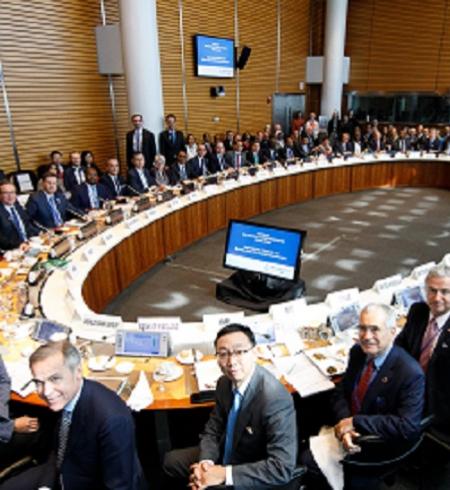
head table
Announced on the margins of COP30 in Belém, the initiative will convene senior fiscal and monetary officials for regular, informal exchanges on how climate and nature-related developments are influencing macroeconomic conditions, inflation, debt sustainability, financial stability, investment needs, and growth prospects. The dialogue series is designed to share approaches, deepen mutual understanding, and support coherent macroeconomic planning for the transition, while fully respecting the distinct mandates and independence of central banks.


The initiative responds to recognition that climate change is not only an environmental concern, but a core economic challenge. Finance ministries and central banks are increasingly engaging with similar transition-related analytical questions, and this series will provide them with structured opportunities for direct and productive exchange.

meeting room
Launch and Next Steps
The launch event, held at the Sustainable Innovation Forum in São Paulo, marked the first in a series of roundtables aimed at fostering practical knowledge exchange between monetary and fiscal authorities.
Following the launch, a series of thematic dialogues will take place over the course of 2026, each hosted by a participating institution and structured around key macroeconomic dimensions of climate change and a resilient low carbon transition. These sessions will incorporate real-world case studies, practitioner perspectives, and opportunities for moderated discussion.
 

Quotes:
Dr. Sam Mugume Koojo, Deputy to the Uganda Finance Minister, Co-Chair of Coalition of Finance
Ministers for Climate Action
“Central banks and finance ministries are each working to understand the economic implications of the climate transition. This dialogue gives us the space to compare approaches, strengthen our analytical foundations, and identify where coordinated action can support a resilient and orderly transition”


Ralien Bekkers, Deputy to the Netherlands Finance Minister, Co-Chair of Coalition of Finance Ministers for Climate Action
“Climate change is increasingly shaping the macroeconomic environment we manage every day—from investment decisions and debt planning to monetary and financial stability. Finance ministries have a responsibility to help ensure the transition is orderly and economically sound. Working closely with central banks, while respecting our distinct mandates, allows us to learn fromone another and helps ensure that no critical issues fall between institutional responsibilities.”


Fundi Tshazibana, Deputy Governor of the South African Reserve Bank, Chief Executive Officer of the Prudential Authority, and NGFS Vice Chair
"Strengthening financial and economic resilience to mitigate the effects of climate change requires collective efforts. This initiative provides a strategic platform for finance ministries and central banks to engage, each bringing their unique capabilities and perspectives to the discussion. Within our distinct mandates and tools, we can strengthen both our institutional and global responses to this critical issue."

Yann Marin, NGFS Secretary General, Deputy Director for Financial Stability at Banque de France
“Climate change and nature degradation are increasingly macro-critical. This dialogue platform offers a unique opportunity to exchange perspectives with finance ministries, ensuring that our respective approaches are informed and coherent. By creating space for dialogue between central banks and finance ministries, we strengthen our collective ability to navigate the transition in a way that supports stability, resilience, and sustainable growth.”


About the CFMCA
The Coalition of Finance Ministers for Climate Action was established in 2019. It brings together 100 Ministries of Finance that are committed to integrating climate considerations into economic and financial policies and to advancing climate-informed fiscal planning and public financial management. The Coalition serves as a platform for Finance Ministries to exchange experience, develop common approaches, and strengthen capacity to support the transition toward a resilient and sustainable economy. The Coalition is currently co-chaired by the Ministries of Finance of the Netherlands and Uganda. The Secretariat is jointly hosted by the World Bank Group and the International Monetary Fund. In addition to its member countries, the Coalition works with 21 Institutional Partners and a wide network of Knowledge Partners that contribute technical expertise and support collaborative initiatives.

For more details, visit the Coalition website, LinkedIn Account, Work Programme, and Climate
Action Statement 2025, or contact the Coalition Secretariat at:
coalitionsecretariat@financeministersforclimate.org

About the NGFS
The Network for Greening the Financial System (NGFS) was launched at the Paris One Planet Summit on 12 December 2017. It represents a group of central banks and supervisors, which are willing to share best practices and contribute to the development of environment and climate risk management in the financial sector, and to mobilize mainstream finance to support the transition toward a sustainable economy. The NGFS brings together 146 central banks and supervisors and 23 observers. The NGFS is chaired by Sabine Mauderer, First Deputy Governor of the Deutsche Bundesbank, with the support of the Vice Chair, Fundi Tshazibana, Deputy Governor of the South African Reserve Bank and Chief Executive Officer of the Prudential Authority. The Secretariat, headed by Yann Marin, is provided by the Banque de France.

For more details, visit the NGFS website, LinkedIn account, and 2024 Annual Report, or contact the NGFS Secretariat at the Banque de France: sec.ngfs@banque-france.fr. Press Office at the Banque de France: +33 (0) 1 42 92 39 00 / presse@banque-france.fr

AGENDA : Implementing NDCs: how Finance Ministries can integrate climate goals into economic strategy

Submitted by Fernanda Vilar on

COP30 High-Level Event of the Coalition of Finance Ministers for Climate Action, Brazil Ministry of Finance, and COP30 Presidency 

Implementing NDCs: How Finance Ministries can integrate climate goals into economic strategy 

15 November 2025, 16.30-18.00, Room São Francisco, COP30 Belém

New HP4 Report: Economic Analysis and Modeling Tools to Assist Ministries of Finance in Driving Green and Resilient Transitions

November 04, 2025

Economic Analysis and Modeling Tools to Assist Ministries of Finance in Driving Green and Resilient Transitions: An Overview of Options and Case Studies of Deployment


Ministries of Finance play a central role in shaping economic, fiscal, and financial policy, and their active leadership is essential for driving climate action. To do so, they need to address challenging policy questions—such as how to finance green energy and resilience measures, manage distributional impacts, and support innovation in low-carbon technologies.

Download it here,

reporthp4

This report provides a systematic overview of analytical tools available to Ministries of Finance to help address these policy questions and integrate climate into their economic analysis. It serves as a reference for Ministries of Finance and their partners that want to explore how climate-related economic policy can be analyzed and diverse tools can be used to support climate-informed decision-makingFor this, the report groups the available tools into four categories for readers to explore: 


  1. Climate-enhanced macroeconomic and sectoral models. These analyze macroeconomic, sectoral, and distributional impacts of aspects of climate change and green and resilient transitions, often building on existing models used by Ministries of Finance.
  2. Physical climate and disaster risk models and approaches. These assess climate damages and risks, informing fiscal risk management and adaptation strategies.
  3. Decision-making frameworks and other analytical tools. These include cost–benefit analysis and robust decision-making and can provide qualitative and quantitative insights that complement other approaches, particularly in contexts of uncertainty and risk.
  4. Ex-post case studies and evaluations. These assess the impacts of implemented climate policies and past transitions, providing insights into effectiveness, challenges, and lessons learned.  


The report covers 23 tools, clarifies their use cases, strengths, and limitations, and provides case studies of their deployment. It also maps tools to policy questions to help Ministries of Finance identify those most relevant to their needs and highlights cross-cutting analytical considerations.  


Through this overview, the following key messages emerge:


  • Different strategies can be used to integrate climate into analytical tools. Ministries of Finance can integrate climate-related factors into their existing economic models and analytical approaches or use tools specifically designed to analyze climate impacts and policies.
  • No single tool can answer all relevant questions. Different policy questions require different tools that can capture different variables and perspectives. Multiple tools and sensitivity analyses can provide complementary insights and help assess the robustness of results.
  • Tools can be linked or used in conjunction for more comprehensive analysis. The boundaries between tools are not rigid, and they can be combined to leverage their respective strengths, enabling analysis that is both more encompassing and more detailed.
  • Continuous learning and development are crucial. Mainstreaming climate in the analysis and decision-making of Ministries of Finance is an evolving process, and peer learning and collaborating with analytical ecosystems are important parts of this.

Finance Ministers Step Up Climate Action Commitments at 14th Ministerial Meeting

October 31, 2025

Finance Ministers Step Up Climate Action Commitments at 14th Ministerial Meeting

At the 14th Ministerial Meeting of the Coalition of Finance Ministers for Climate Action, Finance Ministers from across the world reaffirmed their commitment to integrating climate considerations into economic policy and fiscal planning. 

Watch now what the Ministers of Finance shared about Climate Actions:

Uganda Minister Hon. Henry Ariganyira Musasizi

Croatia's Minister of Finance's speech on becoming the incoming co-chair

Hon. Lekey Dorji, Bhutan's MoF 


https://youtube.com/shorts/ZFFYM5VXz48 

Climate Action Statement: 500+ Climate Policies by Finance Ministries from 70 countries

October 15, 2025

The Coalition of Finance Ministers for Climate Action has released today the third edition of its latest Climate Action Statement and the world’s most comprehensive finance ministry–led database of completed and ongoing climate policy actions.


Over 500 climate policies by finance ministries worldwide show the economic benefits of climate action 

The latest edition of the Climate Action Statement, featuring data from nearly 70 countries, demonstrates that finance ministries are driving economic growth, competitiveness, and resilience through their climate ambitions. 

Washington, DC, October 2025 — The Coalition of Finance Ministers for Climate Action has released today the third edition of its latest Climate Action Statement and the world’s most comprehensive finance ministry–led database of completed and ongoing climate policy actions. 

With the Coalition’s 14th Ministerial Meeting underway during the IMF/World Bank Annual Meetings, this interactive database features over 500 climate policy actions from nearly 70 ministries of finance worldwide. The CAS 2025 highlights how ministries of finance are not only safeguarding macroeconomic stability and fiscal sustainability but also positioning themselves as leaders in seizing the opportunities of the transition to low-carbon, climate-resilient economies amid a rapidly evolving global landscape 


banner


Key highlights:  


  • 82% of the contributing Coalition ministries of finance are strengthening Institutional Frameworks and Governance: Finance ministries are enhancing coordination, transparency, and climate-related decision-making across government systems. Ministries of Finance reported 168 measures to strengthen institutional and governance structures. 

  •  

  • 66% are advancing Financial Instruments and Carbon Markets: Finance Ministries are scaling up green bonds, emissions trading systems, and blended finance to mobilize private capital for climate action. 87 measures are reported in this area, reflecting growing reliance on market-based and financial tools. 

  •  

  • 16% are enhancing Regulatory and Informational Tools: Finance ministries are expanding climate-related disclosures and taxonomies to improve transparency and guide green investment. 77 measures were reported in this area, reflecting growing use of data and reporting standards for climate finance. 

  •  

  • 15% are Integrating Climate Risks into Public Financial Management: Ministries are aligning fiscal frameworks and macroeconomic planning with climate objectives to strengthen fiscal stability. 70 measures were reported on climate-related public financial management reforms. 

  •  

  • 10% are tailoring Environmental Taxes and Fiscal Incentives: Ministries of Finance are introducing carbon taxes, phasing out harmful subsidies, and expanding clean energy incentives. 45 measures were reported on environmental taxation and subsidy reform. 


“Finance ministries play a critical role in shaping the economic signals that guide the transition. By aligning fiscal and general financial policies with climate objectives, we can create clear, predictable frameworks that attract investment, support innovation, and ensure the transition strengthens —not destabilizes— our economies.” — Marko Primorac, Minister of Finance of Croatia and Deputy Prime Minister, Incoming Co-Chair of the Coalition of Finance Ministers for Climate Action.  


“Climate action is central to both economic stability and development. The Climate Action Statement 2025 illustrates how finance ministries playing a more pertinent role in climate policies— aligning fiscal policy with climate priorities, fostering economic resilience, and working towards a more predictable environment for unlocking the investment needed to build sustainable and inclusive economies.” — Hon. Matia Kasaija, Minister of Finance, Planning and Economic Development of Uganda and Co-Chair of the Coalition of Finance Ministers for Climate Action


Climate policies are not the sole remit of Environmental Ministries. This initiative shows how Finance Ministries are transforming climate ambition into economic opportunity. From carbon pricing and green bonds to fiscal reforms and climate-informed budgeting, governments are rethinking how economies grow and compete. By harnessing the low-carbon transition, they are creating new jobs, boosting productivity, and enhancing energy and fiscal resilience—proving that climate action and economic prosperity are mutually beneficial.


beta version


Key links:  

"How Ministries of Finance Can Build Capabilities for Economic Analysis and Modeling to Drive Green and Resilient Transitions"

October 10, 2025

October 2025 — The Coalition of Finance Ministers for Climate Action has released a major new report under its Helsinki Principle 4 (HP4) initiative, titled “How Ministries of Finance Can Build Capabilities for Economic Analysis and Modeling to Drive Green and Resilient Transitions.” This publication marks a significant step forward in supporting Ministries of Finance (MoFs) worldwide as they confront the urgent challenges and opportunities of the climate transition.


cover

Throughout the Coalition of Finance Ministers for Climate Action’s Helsinki Principle 4 initiative ‘Economic Analysis for Green and Resilient Transitions’, a clear message emerges: MoFs are increasingly engaged, interested, and aware of the transition. They understand that delivering on their core mandates of macroeconomic stability, sustainable growth, and sound public finances now increasingly depends on their ability to account for the risks and opportunities of climate change and the green transition.

However, while awareness is high, many Ministries still lack the capacity to act, and few have an explicit mandate on climate action. According to the Coalition’s global survey of Ministries of Finance, only about one-third consider climate action a core economic issue central to their mission. At the same time, most remain at an early stage in developing the analytical tools, data systems, and institutional capacities needed to effectively support and steer green and resilient transitions.

But change is underway. A growing number of Ministries are applying economic analysis to the pressing climate- and transition-related challenges they face and are building their capacities to mainstream climate action into their core mandate and functions. 

The HP4 Capabilities Report provides an overview of strategies, options, and recommendations for how Ministries of Finance can practically enhance their analytical capabilities to drive green and resilient transitions.  

Among the report’s key messages are:

  • Capability is about more than having access to suitable tools and models. It is about being able to identify, use, and maintain suitable tools to answer relevant policy questions, communicating results (and limitations), and ensuring integration into decision-making processes.
  • Ministries of Finance have vastly different levels of analytical capabilities. These have a substantial impact on the type of analysis that could be most suitable and worth investing in, and the priorities and next steps for strengthening local capabilities. Approaches for building capabilities should be pragmatic and consider building on existing capabilities. It is better to ‘start simple’ than wait for more expertise to arrive.
  • Ministries of Finance can build or improve their capabilities over time to meet their needs. This typically requires:
  • Skills:  Building analytical capabilities requires ensuring a few dedicated experts to develop the knowhow in-house with the right mix of skills for conducting or interpreting modeling and analysis are present in the MoF.
  • Collaboration: Ministries of Finance require support from a broader analytical ecosystem, including line ministries and governmimprovingncies to share models, data, and experience; universities and research institutes with climate expertise; and technical assistance providers and the wider international community, which can be critical for many in building expertise and improve access to tools and data.
  • Governance and Leadership: Clear roles, responsibilities, and institutional structures as well as accountability are crucial for ensuring that climate-related economic modeling and analysis are effectively integrated into the Ministry of Finance's decision-making. Policy-makers’ and management’s leadership and backing within governments and the MoF is crucial in making progress.

There is a strong demand for technical assistance providers to ramp up and reform existing offers and training provision to help MoFs develop and maintain their own internal capabilities. To do this, technical assistance providers can work closely together with universities, research institutions, and partners across government.