
















Coalition of Finance Minister events, reports, tools, and highlights 

The Coalition is dedicated to providing insightful news updates on global efforts and progress in achieving climate action goals

New global initiative to deepen knowledge exchange between central banks and finance ministries to manage climate risks.

The Network for Greening the Financial System (NGFS) and the Coalition of Finance Ministers for Climate Action (CFMCA) have launched a new joint dialogue platform to deepen knowledge sharing between central banks and finance ministries on the macroeconomic dimensions of climate change and the transition to a low-carbon economy.

29 January 2026 event

Discover more here.

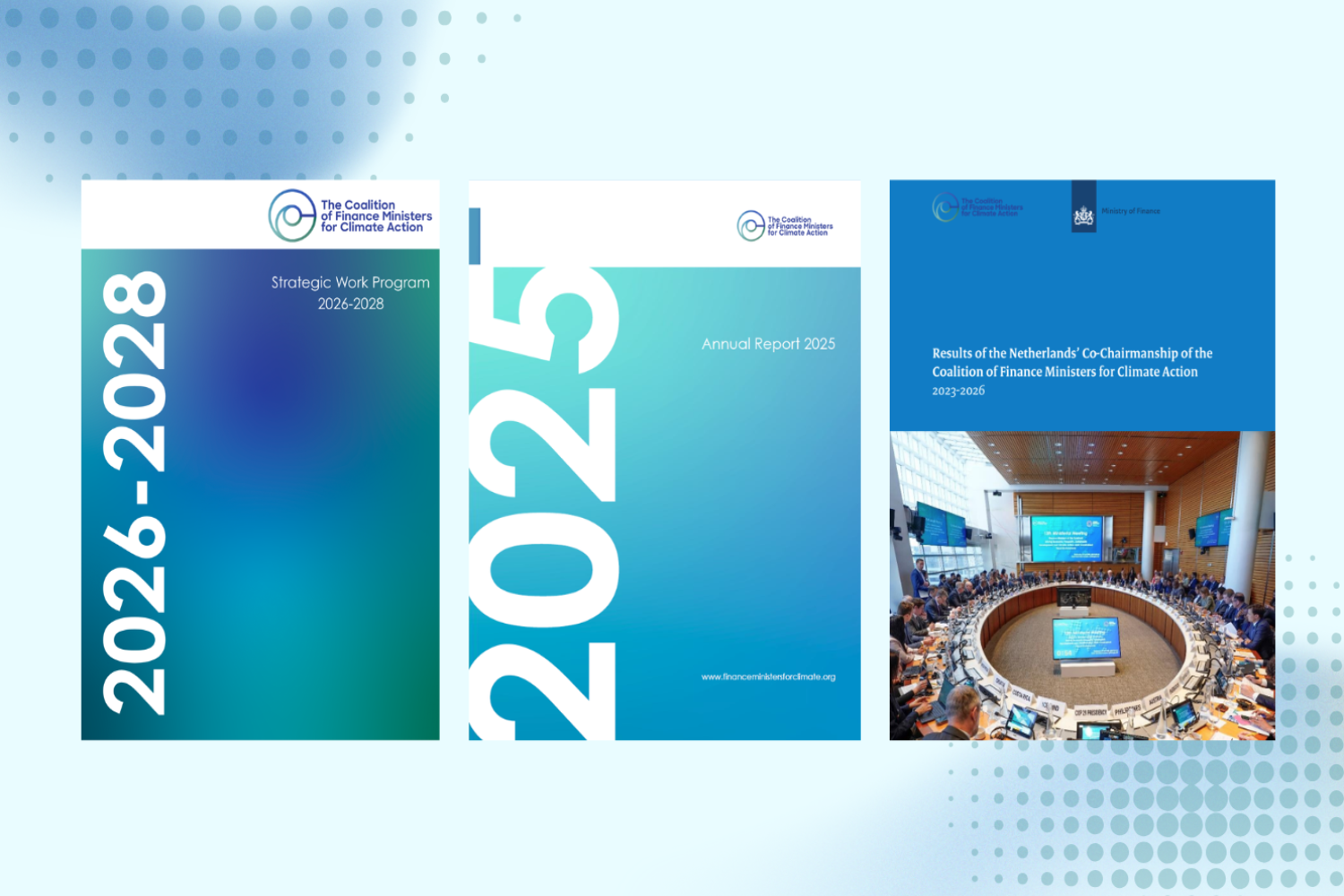
Strategic Work Program 2026-2028

Annual Report 2025

Netherlands Co-Chairmanship Report 2026

During the 15th Ministerial Meeting, the Finance Ministers endorsed the Coalition’s new three-year Strategic Work Program for 2026-2028.

Find out more about the important outcomes of the 15th Meeting here.

About the Coalition

Finance Ministers hold the keys to accelerating climate action. They are most clearly aware of the risks posed by climate change and recognize how taking action could unlock trillions in investments and create millions of jobs by 2030.

The Coalition of Finance Ministers for Climate Action brings together fiscal and economic policymakers from over 100 countries to lead the global climate response and secure a just transition towards low-carbon, resilient development.

Learn More

The Helsinki Principles

The six Helsinki Principles guide the Coalition's commitment to #ClimateAction

Economic Analysis for Green and Resilient Transitions

Economic Analysis for Green and Resilient Transitions (cross-cutting working group)
Read More

Task Group: Updating the Flagship Guide

Task Group: Updating the Flagship Guide
Read More

Thematic Priority 1: Driving a coordinated whole-of-economy transformation

Driving a coordinated whole-of-economy transformation
Read More

Thematic Priority 2: Strengthening macro-fiscal climate policy and debt sustainability

Strengthening macro-fiscal climate policy and debt sustainability
Read More

Thematic Priority 3: Accelerating decarbonization through fiscal instruments

Work towards measures that result in effective carbon pricing
Read More

Thematic Priority 4: Mobilizing private finance for mitigation, transition, and adaptation

Mobilizing private finance for mitigation, transition, and adaptation
Read More

Thematic Priority 5: Planning, managing, and financing adaptation, resilience, and nature

Planning, managing, and financing adaptation, resilience, and nature
Read More

103 Member Countries


Member Countries


Events

View recent and upcoming Coalition events, including workshops, webinars and meetings

Finance Ministers Join Forces to Raise Climate Ambition

April 13, 2019

WASHINGTON, April 13, 2019 — Today, at the Spring Meetings of the World Bank Group and International Monetary Fund, Finance Ministers from more than twenty countries launched a new coalition aimed at driving stronger collective action on climate change and its impacts. The newly formed Coalition of Finance Ministers for Climate Action endorsed a set of six common principles, known as the “Helsinki Principles,” that promote national climate action, especially through fiscal policy and the use of public finance.

The Helsinki Principles – so-called as they were conceived by a group of Governments represented at a meeting led by Finland and Chile in Helsinki in February – are designed to support Finance Ministers to share best practices and experiences on macro, fiscal, and public financial management policies for low-carbon and climate-resilient growth.

The Coalition will help countries mobilize and align the finance needed to implement their national climate action plans; establish best practices such as climate budgeting and strategies for, green investment and procurement; and factor climate risks and vulnerabilities into members’ economic planning.

Finance ministries have a crucial role to play in accelerating the global shift to a low-carbon, climate-resilient growth model,” said World Bank CEO, Kristalina Georgieva. “This Coalition demonstrates new levels of ambition from decision makers in the fiscal policy arena and provides an important platform for Finance Ministers to share best practice on the jobs and growth benefits of the new climate economy.”

"Climate change is a real threat nowadays but we can turn it into an opportunity,” said Felipe Larraín Bascuñán, Minister of Finance, Chile. “Beyond traditional tools like carbon pricing or the phasing out of fossil fuels we can stimulate and signal the private sector to invest in innovative solutions, incorporate this risk and externalities into the investment decision making process. Economic growth is essential but reducing emissions is also essential. We need more ambition and concrete commitments that translate into action.”

"The Coalition will be successful, if it helps us plan concrete, effective policy measures to address the climate crisis nationally, regionally and globally,” said Petteri Orpo, Minister of Finance, Finland. “The Coalition must rely on analytical work and sharing of experiences to achieve solutions that work in practice."

I fully support the new Coalition of finance ministers for climate action. The role that finance can and must play in the transition to a low carbon economy is often underestimated,” said Bruno Le Maire, Minister of Finance, France“Many countries have already developed interesting initiatives at a national or regional level such as green bonds in France or the Emissions Trading System in the EU. Sharing experiences can only be useful. U.N. Secretary-General António Guterres gave President Macron a mandate to accelerate climate finance in the run-up to the Climate Summit in September. In this perspective, we are calling for collectively and urgently step up our actions to meet the Paris Agreement commitment.”

The World Bank will serve as secretariat for the Coalition and will partner with various institutions to provide strategic and technical support to governments, including the International Monetary Fund (IMF)the Organization for Economic Cooperation and Development (OECD)UNFCCC SecretariatUN Development Programme (UNDP), other UN agencies and the NDC Partnership.

Notes for Editors:

The countries that have endorsed the principles are: Austria, Chile, Costa Rica, Cote d’Ivoire, Denmark, Ecuador, Finland, France, Germany, Iceland, Ireland, Kenya, Luxembourg, Marshall Islands, Mexico, Netherlands, Nigeria, Philippines, Spain, Sweden, Uganda, and the United Kingdom. Since the formal announcement the following countries have also signed on: Colombia, Fiji, Guatemala and Norway. 

COP25: Finance Ministers from over 50 countries join forces to tackle climate change

December 09, 2019

Present for the first time at a COP, Finance Ministers launch plan of action

Madrid, December 9, 2019 – Today, at the UN Climate Change Conference, COP25 in Madrid, the Coalition of Finance Ministers for Climate Action launched the Santiago Action Plan that aims to accelerate their countries’ transition to low-carbon and climate-resilient economies.

The Coalition, co-led by Finland and Chile, comprises 51 countries covering 30 percent of global GDP.

It was launched in April 2019 with members endorsing six principles – known as the “Helsinki Principles” – that promote national climate action, especially through carbon pricing, macro-fiscal policy, public budgeting, and financial sector initiatives.

The countries that have endorsed the Helsinki Principles and the Santiago Action Plan are: Argentina, Austria, Bangladesh, Canada, Chile, Colombia, Costa Rica, Côte d'Ivoire, Cyprus, Denmark, Dominican Republic, Ecuador, Equatorial Guinea, Ethiopia, Finland, Fiji, France, Germany, Ghana, Greece, Guatemala, Iceland, Indonesia, Ireland, Italy, Jamaica, Kenya, Latvia, Lithuania, Luxembourg, Madagascar, Maldives, Marshall Islands, Mexico, Monaco, Netherlands, New Zealand, Nigeria, Norway, Paraguay, Philippines, Poland, Portugal, Spain, Sri Lanka, Sweden, Switzerland, Tonga, Uganda, the United Kingdom and Uruguay.

The Santiago Action Plan details how progress will be made on each of the Helsinki Principles. Under the Plan and keeping in mind individual national contexts, Finance Ministers have agreed to work toward actions that include:

  • Sharing knowledge related to the design of new and more effective carbon pricing initiatives, while recognizing the need for comprehensive approaches to supporting people and communities as these are implemented.
  • Building expertise and capacities in Finance Ministries and strengthening competencies for integrating climate into economic policy making.
  • Examining the fiscal costs of climate adaptation and supporting global efforts on transparency and the disclosure of climate-related financial risks, including by identifying the climate risks to financial stability and ways to manage them.
  • Supporting ambitious Nationally Determined Contributions.

Recognizing that climate-smart development must account for immediate needs – such as better jobs, improved social protection programs, and strong institutions and policies that sustain livelihoods – the Santiago Action Plan places strong emphasis on ensuring a just transition, putting people and communities at the center of national decarbonization strategies.

Image removed.

“People are the ones who suffer the pernicious effects of the temperature increase. Also, people are the ones who are suffering the transition to a low-emission economy when this transition is not fair,” said Ignacio Briones, Minister of Finance, Chile. “We should never forget that when we talk about people and citizens it is not only related to the current generation but also about our children and grandchildren.”

“The time to come together as a global community and accelerate the transition to a low carbon and climate-resilient future is now. As Finance Ministers, we stand ready to do our part,” said Mika Lintilä, Minister of Finance, Finland. “Through the Coalition and with this Santiago Action Plan, we can support the design of policies to help address climate change and deliver sustainable growth.”

“At the World Bank we see increasing recognition around the world that action on climate change is good for communities, business and growth,” said Axel van Trotsenburg, Managing Director, Operations, World Bank. “Finance Ministers have the policy levers to push public and private finance towards low-carbon, climate-resilient growth, and networks like this Coalition have an important role in sharing experience and ideas that work.”

“The Fund has been working on climate change which is one of the greatest existential challenges of our time,” said Tao Zhang, Deputy Managing Director of the International Monetary Fund. “We look forward to working with the Coalition of Finance Ministers for Climate Action to galvanize climate efforts at this pivotal moment.”

-- ENDS --

Contacts:

Juan Araya (jaraya@hacienda.gov.cl, + 56 9 6229 9940)

Ministry of Finance, Chile

Pekka Moren (pekka.moren@vm.fi, +358 40 761 9387)

Ministry of Finance, Finland

Notes to Editors:

The World Bank serves as Secretariat for the Coalition.


KEY DOCUMENTS

Overview of the Santiago Action Plan NEW

Joint Ministerial Statement by the Coalition  of Finance Ministers for Climate Action NEW

Agenda - Launch of the Santiago Action Plan